By Zivko Dodovski, Founder & CEO, DoneMaker · Updated September 2026
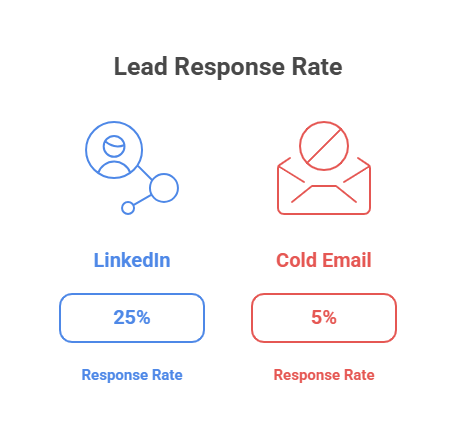
For a B2B service business, LinkedIn beats cold email and cold calling as the first channel, because it is the only one where the prospect can see who you are before deciding whether to answer. Cold email scales further and cold calling gets an answer faster, but both start from zero trust, and trust is the thing that decides whether a stranger books a call with you. This page compares all three on the terms that actually matter, and says plainly when each one fits.
The short version
LinkedIn is a targeted channel. You choose the exact role, industry and company size, and your message arrives attached to a profile that shows your work, your clients and your face. It is slower per contact and it cannot be scaled by software without wrecking it.
Cold email is a volume channel. You can reach far more people for far less money, and you own the list rather than renting access to a platform. The price is that you start as an unknown sender in a defended inbox, and you carry the technical burden of deliverability forever.
Cold calling is an immediate channel. One conversation tells you what a week of messages will not, and some executives genuinely prefer the phone. It is also the most intrusive, the hardest to staff well, and the most regulated of the three.
The honest answer is that all three work for someone. The question is which one fits how you sell.
The comparison
| LinkedIn, manual | Cold email | Cold calling | |
|---|---|---|---|
| How the prospect meets you | A profile: your work, clients, mutual connections | A name and a subject line | A number they don’t recognize |
| Targeting precision | Role, seniority, industry, company size, geography | As good as your list data | As good as your list data |
| Trust at first contact | Highest of the three | Lowest; you are an unknown sender | Low, and often screened before you speak |
| Volume per day | Deliberately limited; we send up to 40 requests by hand | High, capped by deliverability rather than effort | Limited by hours in the day |
| Gatekeeper | LinkedIn’s acceptance behaviour | Spam filters and domain reputation | A receptionist, a voicemail, or a blocked number |
| Ongoing cost | A person’s time | Tools, domains, list data, warmup | A person’s time, and it doesn’t compound |
| What goes wrong | Automation gets the account restricted | The domain gets burned and every future send suffers | Goodwill gets spent, and calling rules vary by country |
| Best first channel when | You sell a B2B service to a nameable buyer | You have a large verified list and someone owns deliverability | Your buyers answer phones and your reps can hold a room |
Why LinkedIn wins for a service business
The profile does work no email can do. Before your prospect answers, they can see how long you have been doing this, who you have done it for, and whether anyone they know vouches for you. In an inbox, none of that exists. The trust that a cold email has to earn over five messages, LinkedIn hands you at the first one.
The targeting is the prospect’s own data. People keep their LinkedIn profiles current because their careers depend on it. A purchased email list decays from the day it is compiled, and every wrong title is a message that tells the recipient you never looked.
Nothing is filtered. A LinkedIn message arrives. There is no spam folder, no domain reputation, no warmup period, no deliverability consultant. What you send is what they see.
And the reason most people fail at it anyway: they automate it. Every advantage above disappears the moment the message could have been produced by software, because prospects recognize it and because LinkedIn restricts accounts that behave like bots. Manual sending is not a preference we have; it is the only version that works. Manual vs automated LinkedIn outreach has the full argument.
When cold email is the better call
We do not run cold email, and we will still tell you when it is right for you.
Pick email first if your buyer is not really on LinkedIn, which happens in trades, manufacturing and parts of the public sector. Pick it if your market is enormous and undifferentiated, so precision matters less than volume. Pick it if you already have a verified list from your own customers or events, because that is not really cold. And pick it if someone on your team owns deliverability as a job, watching the domain, cleaning the list, managing the warmup, because it is a job whether or not anyone is assigned to it.
Avoid it as your first channel if you sell a considered service to a narrow set of decision-makers. The maths that makes email attractive falls apart when your total market is four thousand companies.
The message-level comparison, with what a cold LinkedIn DM should actually look like, is in cold email vs cold LinkedIn DMs.
When cold calling earns its place
The phone still works on people who pick up. If your buyers are owner-operators with a listed number, and you or your rep can run a conversation without a script, calling is faster than everything else here. You learn the objection on the first call instead of the third message.
What makes it hard is not the channel, it is the staffing. Calling well is a skill that takes months to build and burns people out quickly, which is why call teams have the turnover they do. Add the calling rules, which differ by province, state and country, and the overhead is real before the first conversation.
We do not run it and we do not recommend it as a small team’s first channel. A founder who is good on the phone should not be talked out of it.
Using them together, in the right order
Multi-channel does not mean contacting the same person everywhere at once. That reads as pressure, and it is the fastest way to be remembered badly.
The order that works: start on LinkedIn, where the relationship can begin with context. Once the prospect has replied and the conversation is live, email is the natural place for anything long, a proposal, a scope, a document. Once you are exchanging messages regularly and they have offered it, a faster channel keeps momentum. Every step is earned by the previous one.
What does not work is sending a connection request, an email and a call in the same week. That is one channel’s message delivered three times, and it gets you one answer: no. The sequencing across channels is in how to use WhatsApp, LinkedIn and email together, and the wider channel picture is in the guide to cold outreach on social media.
How DoneMaker runs it
We run one channel, manually, for B2B service businesses. A strategist writes the four messages and builds the Sales Navigator list with you. An outreach specialist sends every connection request and every message by hand, every working day, and logs what happens. An account manager runs a weekly strategy call. You take the calls that get booked. No automation tools, no bulk sending, no browser plugins, and no email or phone channel bolted on.
The method itself, message by message, is in the LinkedIn outreach playbook.
DoneMaker by the numbers
As of September 2026:
- Running manual LinkedIn outreach since 2018
- 58+ active client accounts, US and Canada
- Up to 40 connection requests sent per working day, by hand
- 25–30% average connection rate
- 7–11 deal opportunities per account per month
- 4–5 booked calls per account per month
- Clients: accounting, bookkeeping and CFO firms; digital, marketing and advertising agencies; coaches and consultants; B2B services with relationship-driven sales
A deal opportunity is a prospect who expresses clear interest: asks questions, opens an email exchange, or books a call.
How to compare them honestly on your own numbers
Benchmarks published by tool vendors describe that vendor’s customers, not your market, which is why there are none in the table above. Run your own comparison instead.
Pick one channel. Give it a fixed number of contacts and a fixed number of weeks, long enough to include the follow-ups. Then count three things: how many accepted the first contact, how many turned into a conversation with clear interest, and how many booked a call. Those three numbers, on your list, with your offer, are worth more than any published figure. How to measure ROI from LinkedIn outreach sets out the calculation.
Frequently asked questions
Is LinkedIn outreach better than cold email?
For a B2B service business selling to a nameable buyer, yes. LinkedIn starts the conversation with your profile, your clients and your history already visible, and nothing gets filtered on the way. Cold email is the better first channel when your market is very large, your buyer is not active on LinkedIn, or you already hold a verified list.
Can I do LinkedIn and cold email at the same time?
You can, in sequence rather than in parallel. Start the relationship on LinkedIn; move to email once the prospect has replied and you need to send something long. Hitting one person on both channels in the same week reads as pressure and usually ends the conversation before it starts.
Is cold calling dead?
No, it is narrower. It still works when your buyers answer unknown numbers and the person calling can hold a real conversation. What has changed is the cost of doing it well: the training, the turnover, and calling rules that differ by country.
How many people can you actually reach on LinkedIn per day?
We send up to 40 connection requests per working day by hand on each client account, and ramp up to that over the first months rather than starting there. Sending more, or sending with software, is what gets accounts restricted.
Which channel gets the best results?
The one your buyer actually uses, run consistently for long enough to include the follow-ups. Most channel comparisons are really comparisons between a channel someone committed to and a channel they dabbled in.
Want to see what this looks like for your firm? Book a call; 20 minutes, and we’ll tell you honestly whether LinkedIn outreach fits your business before anything else. If you’d rather read first, here is how the service works.