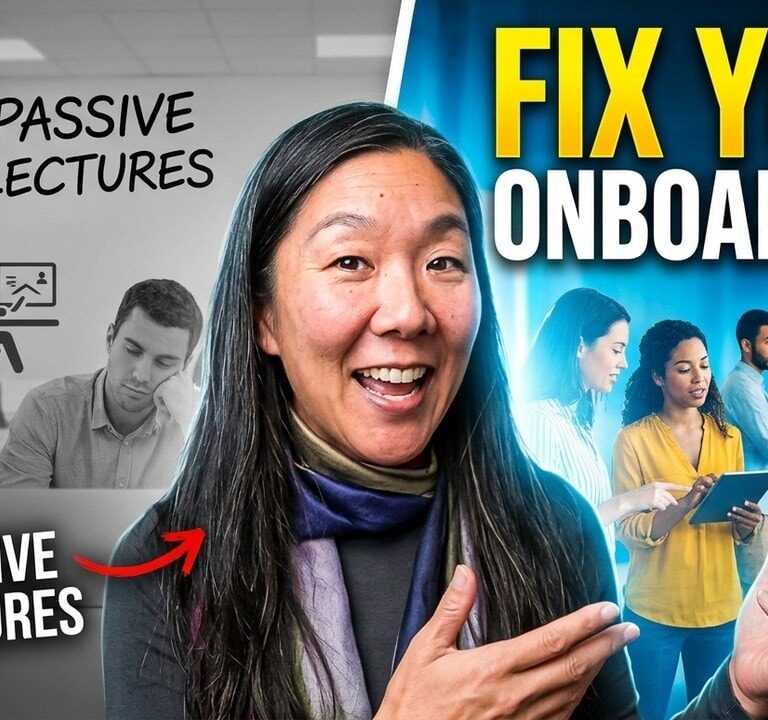
First impressions matter. Too many companies treat onboarding as a checklist: account created, policy slides clicked, a shadowing session squeezed between meetings. That approach leaves new hires overwhelmed, confused, and quietly resentful. The secret? Onboarding is not a training dump. It is an emotional, cultural, and relational moment—the single best chance to make someone feel excited, welcomed, and confident about their place in your company.
Table of Contents
- What most companies get wrong, fast
- Onboarding versus training: different goals, different design
- Why job shadowing often fails
- Design onboarding as relationship engineering
- Remote culture: stop scheduling “informality”
- How to use videos and SOPs the right way
- Work backwards: design training from the outcome
- Training isn’t the solution most of the time
- Four-step feedback framework that actually works
- Let people make mistakes—safely
- Experimentation and motivation: the compounding effect
- Onboarding blueprint: a practical 30/60/90 and day-one plan
- Measuring onboarding success
- Templates and scripts you can copy
- Common onboarding problems and quick fixes
- Final takeaways: change the conversation
- How is onboarding different from training?
- When should I use videos or SOPs?
- What should a manager do on day one?
- How do I give feedback without demoralizing someone?
- Is letting people make mistakes really a good idea?
- How do I know if the problem is training or something else?
What most companies get wrong, fast
Three myths sabotage onboarding every day:
- Myth: If they watched it, they learned it. Reality: watching is passive and rarely transfers skill.
- Myth: Onboarding equals knowledge transfer. Reality: the first days are for relationship building and cultural signalling.
- Myth: Throwing a video or a single SOP at a problem fixes performance gaps. Reality: training is a tool—not a cure-all.
Fixing onboarding starts with changing how you think about it. Instead of “deliver everything,” aim for “what feeling and capability do we want someone to leave day one with?”

Onboarding versus training: different goals, different design
Most people blur onboarding and training into one experience. That’s the root of many problems. Training is about knowledge and skill acquisition—specific tasks, steps, tools. Onboarding is an onboarding is an experience: first impressions of culture, social access, clarity about how the organization treats people, and relationships that make learning possible later.
When onboarding focuses too heavily on content, new hires get a mouthful of facts without a story. They can leave day one with a spreadsheet of jargon and links, but no sense of where to start or who to ask. Conversely, when onboarding is relationship-first, it buys time for spaced learning: bite-sized skill development scheduled across the first weeks and months, supported by approachable people.
What winning onboarding feels like
The best onboarding makes someone want to tell their family they found an amazing workplace. That emotional lift—energy, curiosity, approachability—drives motivation to learn and stick around.

Why job shadowing often fails
“Sit next to me and watch” is comfortable for the host and painless for an overstretched HR calendar, but it creates three predictable outcomes:
- Passive learning: Watching isn’t doing. People retain far less when they are observers, especially if there’s no guided practice.
- Missing context: Observers see fragments—meetings, notifications, a few workflows—without the backstory or decision rules that make those fragments meaningful.
- Cognitive overload: New hires take frantic notes, leave with pages of disconnected information, and then fail to translate it into real action.
Fix it: transform shadowing into structured, active learning. Replace passive observation with micro-tasks, guided rehearsals, and short debriefs that explicitly connect what was seen to how to do it.
Practical replacement for blind shadowing
- Pair a 15-minute focused demo with a 30-minute hands-on task that the new hire completes with guidance.
- Provide a one-page decision log explaining why certain choices are made (who to escalate to, when to pause a task, what templates to reuse).
- End each session with a 10-minute debrief: What did you notice? What surprised you? What do you need clarified?

Design onboarding as relationship engineering
Skills can be taught later. The early win is showing a new hire that the organization is a place of friendly experts and accessible leaders. Storytelling from leaders—real tales about why the work matters and how the organization overcame obstacles—beats a slide with mission statements every time.
A simple ritual works wonders: on day one, a leader spends 20–30 minutes with the new person telling stories, answering curiosities, and sharing a personal anecdote or two. That single interaction signals openness and approachability far more effectively than ten mandatory policies.

Quick checklist to prioritize relationships on day one
- Schedule a 20–30 minute informal conversation with a senior leader who shares personal stories, not org charts.
- Arrange three 1:1 meet-and-greets with cross-functional peers (15 minutes each) focusing on people and processes.
- Give the new hire a buddy for 30 days—someone who checks in daily for the first week and then every few days.
- Give a simple “welcome pack” with the team Slack channels, where to find help, and one fun, human fact about the team (favorite snack, secret recipe!).
Remote culture: stop scheduling “informality”
Remote teams tried to replace watercooler talk with scheduled social hours and forced celebrations. The result? Awkward breakout rooms, low attendance, and people feeling obliged to perform social energy. Informality cannot be manufactured on a calendar—forced fun often backfires.
Better approach: create optional, low-friction channels for social connection and let people slide in when they want. Mix synchronous and asynchronous options so everyone can participate in a way that suits them.
How to make remote culture real (without forcing it)
- Create interest-based channels (coffee, pets, running, parenting) and make them clearly optional.
- Encourage micro-interactions during work hours: “pop-in” voice channels or short, optional standups where people talk about how they take breaks.
- Celebrate contributions inside the flow of work—highlight wins in operational threads rather than one-off party calls.
- Make it safe for people to meet colleagues one-on-one and reimburse small, local meetups where appropriate.
How to use videos and SOPs the right way
Companies love creating videos and SOPs. They feel modern and scalable. But improperly used, they become compliance checkboxes that employees resent. Videos are a format, not a solution—great for simple, procedural tasks but poor for nuanced, interactive learning.
Use videos when the task is:
- Highly procedural and repeatable (a short orchestration, a tool shortcut, or setup step).
- Visual and benefits from seeing a motion or screen walkthrough.
- A micro-skill that takes 60–120 seconds to demonstrate and 3–5 minutes to practice.
Avoid long, one-size-fits-all e-learning that tries to cover everything. If an hour-long module could be a one-page checklist, choose the checklist. If the content requires judgment, role-play, or decision-making, design an interactive exercise instead of a lecture.

Work backwards: design training from the outcome
Start with the end in mind. Ask: what should a person be able to do after this onboarding or training? Define observable behaviors and success criteria, then design backwards from there.
- Define the outcome: what specific tasks or decisions should the person make independently in 30 days?
- List the knowledge and skills needed to reach that outcome.
- Choose the learning activities that match the skills (practice, coaching, simulations, microlearning).
- Put checks in place: short assessments, live demos, and feedback moments that prove competence.
When you always start with the type of content you want to produce (video, slide deck, workshop), you risk selecting the wrong tool for the job. Start with performance outcomes and pick a modality that supports active practice and feedback.
Training isn’t the solution most of the time
Here is a blunt truth: more than half the time, poor performance isn’t a training problem. It is an organizational problem. Before creating another module, test whether the person lacks knowledge or lacks clarity, feedback, or tools.
Common non-training root causes
- No clear expectations or role definition.
- Insufficient feedback loops—people aren’t told when they deviate from expectations.
- Poor tooling or environment—slow laptops, missing access, or unsuitable processes.
- Culture signals that penalize trial and error, discouraging experimentation.
If the barrier is one of these, a training module is just lipstick on a structural problem. Fix the org problem first and training will become far more effective.

Four-step feedback framework that actually works
Feedback is the most powerful tool leaders have, but most of it lands poorly. Use a short, repeatable structure to give constructive, non-demoralizing feedback that drives behavior change.
The four steps
- Empathy: Open with understanding. Acknowledge difficulty or context so the person feels supported.
- Specificity: Identify the exact behavior or moment. Vague criticism is demoralizing. Give observable facts.
- Impact: Explain the consequence of the behavior. Why does it matter to the team, the client, or the outcome?
- Positivity: End with a concrete next step and a positive observation or encouragement to reinforce capability.
Example: cold-calling feedback
“I know cold-calling is tough—most of us do not enjoy it (Empathy). On yesterday’s call you spoke very quickly and didn’t pause between questions (Specificity). Because of that the prospect had trouble following and we lost the chance to surface their needs (Impact). Try slowing down and leaving a 2-second pause after each question—let’s role-play one call now; I’m already seeing improvement (Positivity).”

Why this works
- Empathy lowers defenses and builds trust.
- Specific, actionable guidance avoids guessing games.
- Impact connects behavior to outcomes so the change feels meaningful.
- Positive reinforcement amplifies motivation and shows the leader believes in improvement.
Let people make mistakes—safely
People learn best from their own mistakes. The trick is allowing low-risk experiments and debriefing them properly so the learning sticks. For safety-critical roles or regulatory work, keep guardrails tight. For creative problem solving, widen the sandbox.
How to let mistakes teach
- Set clear boundaries: what is safe to experiment with and what is not.
- Allow small, time-boxed experiments—pilot a campaign, A/B a process, try a different outreach message.
- Hold a structured debrief: ask the person to explain their thinking, what assumptions they made, what they would change next time.
- Capture learning as a short note in a shared repository so the team benefits.
The debrief is the magic. If a person just fails and moves on, the lesson evaporates. If you interrogate the thinking process—What did you expect? What happened instead?—the mistake becomes data and the person becomes wiser.

Experimentation and motivation: the compounding effect
Start small. Success builds motivation. One tiny win in a new skill fuels curiosity for the next step. That’s how competency scales: tiny, frequent experiments, feedback, and increasingly ambitious tasks.
Video games illustrate this perfectly: you learn one button, get a reward, and then want to unlock the next level. Design learning with the same principle—micro-skill, reward, next task.

Onboarding blueprint: a practical 30/60/90 and day-one plan
Below is a tested onboarding blueprint that balances relationship, culture, and learning. Use it as a template and adapt to your context.
Pre-day one
- Send a welcome email with first-day agenda, contact list, and a 5-minute “what to expect” video from the hiring manager.
- Set up accounts, tool access, and make sure equipment arrives in time.
- Assign a buddy and schedule a 30-minute informal coffee on day one.
Day one
- Administrative essentials in the morning (pay, legal, basic security) but keep this under 60–90 minutes max.
- Leader story session (20–30 minutes): a senior leader shares origin stories and values—no slides, just stories.
- Team welcome and quick 15-minute intro from each key teammate (not process dumps—focus on what they love about working here).
- Buddy shadow session: 30 minutes of joint work followed by a 10-minute debrief on what the new hire tried and what they noticed.
- Close the day with a short “how was day one?” check-in from manager and an expectation-setting note on week one.
Week one
- Microlearning modules scheduled across the week for tool basics—each under 20 minutes.
- Structured practice sessions: one small task per day with feedback loops.
- Two short check-ins with the buddy and two with the manager.
- An explicit 30-minute reflection session at end of week: what was confusing? What felt good? What support is needed?
30/60/90 day milestones
- 30 days: able to perform 2–3 core tasks independently; demonstrated by a live or recorded demo; manager provides specific feedback using the 4-step framework.
- 60 days: handling full workflows with occasional support; contributed one improvement suggestion to a process.
- 90 days: fully integrated into team rhythms, responsible for deliverables, and paired with a development plan for the next 6 months.
Checklist for managers
- Create the day-one experience: leader story, buddy, and no oppressive admin overload.
- Schedule weekly coaching time for the first month.
- Use the four-step feedback framework for correcting and reinforcing behaviors.
- Assess whether gaps are training, tooling, or clarity and act accordingly.
Measuring onboarding success
Track metrics that reflect experience and capability, not just course completions. Useful KPIs include:
- New hire sentiment after day one and week one (quick pulse surveys).
- Time to first independent task completion.
- Quality of early work (manager rating against a rubric at 30 days).
- Retention and engagement at 90 days and 6 months.
Combine quantitative measures with short qualitative interviews: ask new hires “what helped you most?” and “what would you change?” The answers are gold.
Templates and scripts you can copy
Here are ready-to-use micro-scripts to make feedback, leader stories, and debriefs easier.
Leader story opener (20–30 minutes)
“When I joined, the first thing I noticed was how messy our processes were. There was this one project where everything went sideways because we didn’t talk to Ops. I spent the first six months just listening. That taught me two things: how to ask better questions and why making mistakes fast and cheap is okay. That shaped how we hire for curiosity, not perfection.”
Buddy debrief script (10 minutes)
- What felt clear to you today?
- What was confusing or surprising?
- If you could change one thing about today, what would it be?
- One small task to try tomorrow and what success looks like.
Feedback micro-script (4-step)
“I know this is a tricky task for everyone (Empathy). I noticed you handled the client call by summarizing late and skipping a recap (Specificity). That meant the client left without clarity about next steps and the team had to follow up again (Impact). Next time, try a two-sentence recap at the end and ask ‘do you agree with these next steps?’—let’s try that on the next call; I think you’ll see better outcomes (Positivity).”

Common onboarding problems and quick fixes
- Problem: New hires are overwhelmed by admin. Fix: Move admin to pre-day one and keep day one human-focused.
- Problem: Training modules are ignored. Fix: Replace long modules with micro-practice and a real task that proves capability.
- Problem: Remote “social” events are awkward. Fix: Invest in asynchronous community channels and optional micro-events led by employees.
- Problem: People hide behind training instead of managing. Fix: Train managers to give feedback and measure manager coaching as a key KPI.

Final takeaways: change the conversation
Stop treating onboarding like a content delivery problem. Make it a people-first, relationship-first design problem. Be ruthless about removing friction in the first days. Give managers permission and time to coach. Use videos and SOPs where they help, but never as a substitute for human connection and structured practice. Measure what matters: feeling, capability, and retention.
When the first day is energizing rather than bewildering, everything else becomes easier. People will try harder, experiment more, and stick around longer. That is the payoff of great onboarding.
How is onboarding different from training?
Onboarding is the early emotional and relational experience that introduces new hires to culture, people, and expectations. Training is the deliberate transfer of knowledge and skills. Onboarding should prioritize relationships and clarity; training can be spaced and targeted after initial connection and context are established.
When should I use videos or SOPs?
Use short videos and SOPs for procedural, repeatable tasks that benefit from a visual guide. Keep them micro (under 3 minutes) and pair the content with a hands-on task so the learner practices—the video is the demonstration, not the endpoint.
What should a manager do on day one?
Prioritize a story-led 20–30 minute session with a senior leader, schedule three short intro calls with teammates, set up a buddy, and confirm the new hire has one real task to try before the end of the week with feedback scheduled.
How do I give feedback without demoralizing someone?
Use the four-step framework: open with empathy, be specific about the behavior, explain the impact, and close with a positive action and encouragement. Make feedback immediate, frequent, and future-focused so it feels like coaching, not judgment.
Is letting people make mistakes really a good idea?
Yes—when done safely. Allow small experiments with clear boundaries and follow up with structured debriefs that surface the person’s thinking. Mistakes become learning when leaders treat them as data and guide reflection.
How do I know if the problem is training or something else?
Diagnose by asking: does the person lack knowledge or clarity? Do they receive feedback? Do they have the right tools? If the answer points to unclear expectations, missing feedback, or poor tooling, fix those before building training.