Your team can deliver great results and still leave everyone frustrated. Payments arrive, targets are met, and clients are happy. Yet a conversation with a colleague or partner can drain your energy faster than the work itself.
That is a communication problem worth solving. Relationships are not a pleasant extra layered on top of performance. They are how people coordinate, make decisions, keep commitments, and get things done.
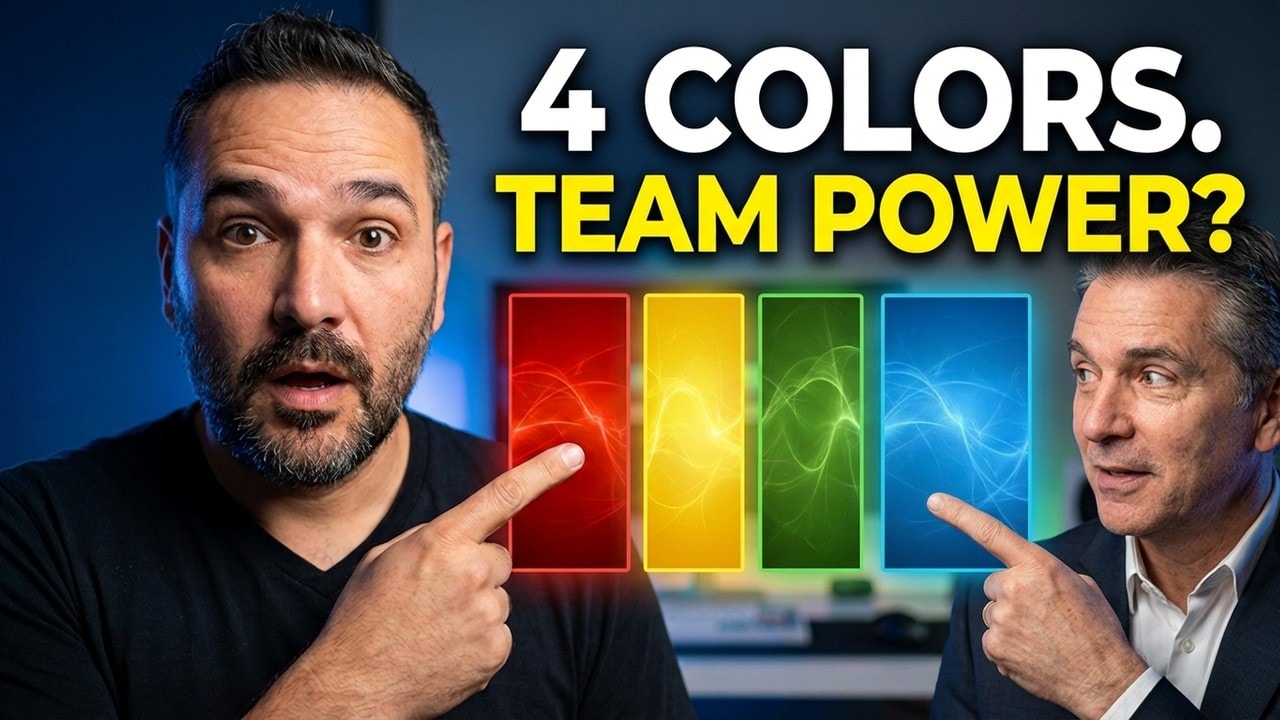
Insights Discovery offers a memorable way to understand those interactions through four color energies: Fiery Red, Sunshine Yellow, Earth Green, and Cool Blue. Each describes a different set of personality preferences. Together, they give teams a shared language for discussing what helps them work well and what gets in the way.
The big opportunity is not sorting everyone into four categories. It is recognizing your default approach, appreciating someone else’s, and adapting before a small misunderstanding becomes an exhausting pattern.
Table of Contents
- Why Connection at Work Is a Performance Issue
- What Is Insights Discovery?
- The Four Color Energies Explained
- Two Questions That Help You Adapt Your Communication
- Why Similar People Can Clash Just as Hard as Opposites
- A Real Communication Problem: Too Many Ideas, Too Little Room to Execute
- The Four Fs for Remote and Hybrid Teams
- Why Insights Discovery Should Not Be Used for Hiring
- High Performance Can Hide an Energy Cost
- Turn Color Awareness Into Better Teamwork
Why Connection at Work Is a Performance Issue
Consider the scale of a working life. Using a 35-year career as a reference, Earl Hoeg of PeopleFirst puts the time spent at work at roughly four million minutes. That is a huge portion of life shaped by everyday interactions.
Improving those interactions matters for both happiness and execution. When people feel seen, heard, and understood, working together becomes easier. When they continually misread one another, even straightforward work can become tangled.
Hoeg calls this relational friction: the misunderstandings that arise because colleagues do not understand each other’s preferences or intentions.
The costs are practical. A message does not land, so someone explains it again. A discussion keeps changing direction, so work must be redone. A colleague interprets a different communication style as a lack of care, then spends time replaying the exchange.
Better connection does not eliminate difficult conversations. It gives people a more respectful, objective way to have them. That is why team communication belongs alongside accountability, processes, and results, not beneath them.
What Is Insights Discovery?
Insights Discovery is a psychometric system based on Carl Jung’s work on personality preferences, which dates back to 1921. Like other personality frameworks, it aims to increase self-awareness. Its practical value comes from applying that awareness in relationships.
The process begins with an online evaluator that takes approximately 20 minutes. Participants respond to sets of statements about what describes them best. Those responses produce a detailed profile of their personality preferences.
But the profile is a starting point, not the finish line. The useful progression is:
- Understand yourself: Recognize how you naturally communicate and approach situations.
- Appreciate differences: Accept that other people may work differently, without assuming they are wrong.
- Adapt your behavior: Respond in the way the relationship or situation needs.
Self-awareness becomes valuable when it changes an interaction. Knowing that you love brainstorming is interesting. Recognizing when your colleague needs you to stop brainstorming and commit to a plan is useful.
Preferences Are Not Competencies
This distinction is the foundation of the entire system: a preference describes what comes naturally, not what you can do.
Think about crossing your arms. One arrangement probably feels automatic. Reverse it, and the movement may feel awkward, but you can still do it. Your preference has not removed your ability to act differently.
Personality preferences work in a similar way. Someone who naturally prioritizes relationships can still hold people accountable. Someone who enjoys ideas can still produce a detailed report. Someone who needs quiet reflection can still lead an energetic group session.
Everyone has access to all four color energies. Their order and relative strength differ. There is no ideal sequence, no superior color, and no combination that automatically makes someone a better leader.
The goal is greater choice, not a more colorful set of limitations.
The Four Color Energies Explained
Fiery Red: Results, Directness, and Momentum
Fiery Red energy focuses on getting things done. It brings urgency, decisiveness, and a strong appetite for progress. People accessing this energy want to move toward the outcome rather than circle around it.
You may recognize it in someone who finishes sentences, gets straight to the request, or sends an email with everything contained in the subject line. One example involved a manager adding “EOM,” meaning “end of message,” to make clear that the short subject line really was the whole communication.
For this preference, brevity is often a feature, not an insult. A concise request may simply reflect a desire to save time and move forward.
To communicate effectively with Fiery Red energy:
- Make your point clearly and quickly.
- Connect the discussion to the result.
- Avoid burying the request beneath unnecessary explanation.
Results orientation does not mean someone is cold or uncaring. They may express care by doing something helpful, solving a problem, or honoring a commitment. The action carries the message.
Sunshine Yellow: Ideas, Enthusiasm, and Involvement
Sunshine Yellow energy brings innovation, persuasion, and enthusiasm. It wants to participate, contribute, and help a promising idea grow.
Share a possibility with someone accessing this energy, and they may immediately add three more possibilities. They are not necessarily trying to take over. They are excited to be involved.
This is the colleague who volunteers beyond their formal responsibilities, eagerly joins a conversation outside their specialty, or arrives at a Monday meeting with stories about everyone they met over the weekend.
The communication need is participation. Give this energy space to contribute rather than treating every additional thought as an interruption.
However, a strength taken too far can create trouble. Enthusiasm can become haste. A steady flow of ideas can make a discussion feel frantic. Before one topic is settled, another appears.
The challenge is not stopping creativity. It is recognizing when the team needs to move from generating ideas to executing them.
Earth Green: Care, Harmony, and Relationships
Earth Green energy emphasizes diplomacy, caring, and connection. It pays attention to people and to the quality of the relationships between them.
Its listening can be especially valuable. Someone accessing Earth Green may notice not only what a colleague says, but also what remains unsaid.
A simple example is organizing a team potluck. While others focus on getting the event scheduled or making it exciting, Earth Green energy checks allergies, considers food variety, and makes sure everyone is included.
That attention helps support trust and cohesion. It also has a potential cost: caring for others so consistently that personal needs go unspoken.
Protecting a relationship should not require repeatedly accepting a lose-win arrangement. Someone else’s needs matter, but yours do too.
When communicating with Earth Green energy, demonstrate genuine consideration. Acknowledge the people affected by the decision. Make room for concerns rather than assuming that silence means everything is fine.
Cool Blue: Logic, Detail, and Process
Cool Blue energy focuses on analysis, accuracy, and a clear route from the starting point to the outcome. It asks how the work will happen and whether the plan makes sense.
This energy protects systems and processes. It wants measurements, supporting information, and a sound execution plan.
In a discussion about a campaign or experiment, Cool Blue questions might focus on the numbers, the duration of an A/B test, or the process for assessing the result. Those questions are not automatically resistance. They may be the work required to make the idea executable.
To communicate effectively with Cool Blue energy:
- Provide relevant detail and logic.
- Explain the process, not just the ambition.
- Allow room for questions and reflection.
Someone who does not naturally enjoy building systems may still follow them effectively. Likewise, a person who asks detailed questions is not incapable of understanding relationships or human behavior. Preference is not a boundary around intelligence or skill.
Two Questions That Help You Adapt Your Communication
The four colors are easy to remember because they connect to broader preference patterns. Two questions can help you begin thinking about another person’s communication needs.
Use them as clues, not a substitute for a formal profile or a confident diagnosis of someone else.
1. Do They Tend to Think Aloud or Reflect First?
Within this framework, Fiery Red and Sunshine Yellow connect with extraverted preferences. Earth Green and Cool Blue connect with introverted preferences.
Someone with a stronger extraverted preference may be more outgoing and talkative. They may work out what they mean while speaking. Someone with a stronger introverted preference may pause, reflect, and think before contributing.
Neither approach is better. The friction starts when one person assumes their own pace is the correct pace for everyone.
These preferences also concern energy. Quiet reflection and time alone may help one person recharge, while interaction may energize another. Visible confidence does not tell the whole story.
2. Do They Emphasize Logic or the Impact on People?
Cool Blue and Fiery Red connect with thinking preferences. Sunshine Yellow and Earth Green connect with feeling preferences.
The distinction concerns how people evaluate decisions. Thinking preferences tend to emphasize logic and objective considerations. Feeling preferences give particular weight to people, values, and relationships.
“Feeling” does not mean being emotional, just as “thinking” does not mean being more intelligent. Everyone can use both.
Combining the two questions creates a simple orientation:
- Extraverted and thinking: Fiery Red.
- Extraverted and feeling: Sunshine Yellow.
- Introverted and feeling: Earth Green.
- Introverted and thinking: Cool Blue.
The wider system also includes sensation and intuition preferences. The two questions above are simply an accessible starting point. Behavior sits on a continuum and can change with the situation or relationship.
Why Similar People Can Clash Just as Hard as Opposites
It is tempting to assume your most difficult colleague must be your psychological opposite. In the color system, Sunshine Yellow and Cool Blue are opposites, as are Fiery Red and Earth Green.
Those differences can certainly create misunderstandings. An idea-focused person may experience detailed questions as deflating. A detail-focused person may experience unstructured enthusiasm as incomplete.
But similarity does not guarantee an easy relationship. Two highly extraverted people may both want the airtime. Two enthusiastic idea generators may keep expanding a discussion until neither can finish a thought.
The answer is not deciding which person has the wrong personality. It is recognizing the pattern and making space for a different interaction.
This applies beyond work, too. A partner sharing an exciting travel possibility may want to explore the idea, not immediately hear why it cannot happen. A practical response can miss the connection being offered, even when the response is well intended.
Before responding, understand what the conversation is for. Is the person inviting possibilities, asking for a decision, seeking reassurance, or working through execution?
A Real Communication Problem: Too Many Ideas, Too Little Room to Execute
A discussion of DoneMaker’s Zivko and his profile brings these principles into focus. His strongest preference was Sunshine Yellow, followed by Fiery Red. Earth Green came next, close to the profile’s midline, while Cool Blue was least preferred.
That combination made sense in practice: lots of ideas, a desire to accomplish a lot, and strong concern for relationships. Building detailed systems was less enjoyable, although following a system created by someone else was not a problem.
He had already recognized one implication of his enthusiasm. Starting too many things made finishing them properly harder, so he had adopted a limit of three major initiatives at a time.
The surprise was his results orientation. He connected it with years of running a business and making promises to people. Caring about the relationship meant wanting to deliver what he had committed to.
The Frustration Was Not Poor Performance
The recurring problem involved a partner and LinkedIn outreach campaigns. Results were good. Payments were not the issue. Communication was.
The partner kept introducing new ideas and requesting changes faster than they could be implemented and evaluated. Each fresh direction made it harder to stay with the agreed plan and demonstrate results.
The resulting loop was exhausting: agree on a direction, receive more ideas, feel pressure to change, and struggle to deliver against a moving target.
Using the preference questions, the partner appeared outgoing and relationship-oriented. Hoeg suggested that Sunshine Yellow might be a leading preference, potentially supported by Earth Green. This was a working interpretation, not a confirmed profile.
The Clash Was Between Similarities and Different Priorities
Both people could connect through enthusiasm and ideas. The conflict appeared when Zivko wanted to shift toward Fiery Red: enough possibilities had been discussed, and it was time to execute.
The partner might still have been prioritizing possibilities and client relationships, introducing more changes out of a desire to serve people well.
That interpretation changes the conversation. The issue is no longer simply that someone is being random or difficult. Two people may care about the same outcome while expressing that care differently.
One seeks to protect the relationship through responsiveness. The other seeks to protect it through reliable delivery. Without recognizing the difference, both can feel that the other is undermining the work.
Separate Idea Generation From Commitment
The practical move is to acknowledge the value of brainstorming while making the transition to execution explicit.
Agreeing to explore an idea is not the same as agreeing to implement it immediately. A team needs room for both enthusiasm and follow-through. When new suggestions arrive, the discussion can return to how they affect the existing plan and the ability to deliver.
The shared color language helps make that shift less personal. It gives colleagues a way to recognize that the conversation needs a different emphasis, rather than arguing over whose intentions are better.
That is how self-awareness starts removing relational friction: not by excusing disruptive behavior, but by making the behavior easier to discuss and adjust.
The Four Fs for Remote and Hybrid Teams
Remote work does not remove these communication needs. It makes deliberate agreements especially valuable.
Even teams in the same organization are often distributed across floors, buildings, or locations. The central question is therefore broader than office attendance: how will this group collaborate effectively wherever people happen to be?
Hoeg’s “Give an F” approach connects four operating needs with the four color energies.
Focus: Shared Purpose and Accountability
Focus connects with Fiery Red. The team needs clarity about why it exists, where it is going, and how accountability works.
That means making implicit expectations explicit. Shared purpose is not enough if people interpret responsibilities differently. A team needs to know what it is working toward and how it will hold itself accountable for progress.
Flexibility: Freedom Within an Agreed Structure
Flexibility connects with Sunshine Yellow. It allows people to collaborate and contribute without turning the working environment into a free-for-all.
The key is flexibility within a framework. Document how the team wants to communicate and collaborate. Flexibility works better when colleagues understand the agreements around it rather than relying on conflicting assumptions.
Foundation: Trust, Cohesion, and Psychological Safety
Foundation connects with Earth Green. It asks how the team will build the trust and cohesion needed for people to work well together.
Psychological safety matters because the team needs people to contribute honestly, not merely comply quietly. Hoeg emphasizes the connection between higher trust, lower stress, and greater energy and productivity.
Relationships are therefore part of the operating foundation, not an optional social layer.
Frameworks: Systems and Processes That Support the Work
Frameworks connect with Cool Blue. The team needs systems and processes that support its goals and working agreements.
Purpose without a process leaves execution unclear. Flexibility without shared expectations invites confusion. Trust without accountability is incomplete.
The four Fs work together. Documenting them gives a team a clearer basis for collaboration, whether colleagues share an office or work across the globe.
Why Insights Discovery Should Not Be Used for Hiring
The colors can make role matching sound appealing. Put a Red in charge of results. Ask a Blue to create processes. Choose a Green for relationships.
But that shortcut confuses preference with capability. Insights Discovery should not be used as a hiring or staffing tool. It describes preferences, not competencies.
Hoeg illustrates this with a research and development leader at a consumer products company. Her colleagues associated her with Cool Blue because she was highly effective at detailed work and executed her role well.
Her actual preference order began with Sunshine Yellow and Fiery Red, followed by Earth Green. Cool Blue was least preferred.
She could do the work exceptionally well. It simply required conscious effort to dial down her more natural energies and concentrate on the detail.
Patterns may appear across occupational groups. Hoeg has seen more Cool Blue and Earth Green in accounting workshops, more Sunshine Yellow and Fiery Red in marketing, and strong Fiery Red and Cool Blue combinations among engineering leaders.
Those are observations, not rules for who belongs in a profession. Any preference combination can succeed in a role. Use the system for development, communication, and self-understanding, not to decide what someone is capable of achieving.
High Performance Can Hide an Energy Cost
A person’s polished performance may conceal how demanding the task feels. The R&D leader demonstrates one version of that gap. A skilled facilitator provides another.
During an afternoon session, the facilitator brought tremendous energy to the room. She was lively, engaging, and highly effective. Her performance could easily have suggested a strong extraverted preference.
Afterward, she wanted a walk alone. When a colleague asked to join her, she agreed only if they kept their distance. She understood that she needed quiet time to recharge.
The lesson is powerful: being good at a behavior does not mean that behavior restores your energy.
Leaders need access to all four energies because different situations demand different responses:
- Results leadership: Fiery Red.
- Relationships leadership: Earth Green.
- Visionary leadership: Sunshine Yellow.
- Centered leadership: Cool Blue.
A relationship-oriented leader may need to run a demanding accountability meeting. An enthusiastic leader may need to spend sustained time completing a detailed report. Neither situation automatically means the person is in the wrong role.
However, operating outside a natural preference can be tiring. Without self-awareness, people may interpret that strain as personal inadequacy: they believe they should simply find it easier.
Recognizing the effort allows a more constructive response. Prepare for the situation, access the behavior it requires, and allow time to recharge afterward. The aim is not avoiding every demanding task. It is understanding the energy needed to perform it.
Turn Color Awareness Into Better Teamwork
The best use of Insights Discovery is practical and generous. Notice your defaults without treating them as excuses. Appreciate someone else’s preferences without reducing them to a label.
In your next difficult interaction, pause over three questions:
- What am I naturally bringing? Ideas, urgency, care, detail, or a combination?
- What might the other person need? More brevity, involvement, consideration, or information?
- What does this situation require now? Reflection, brainstorming, a decision, accountability, or a clearer process?
Those questions shift attention from judging personalities to improving the interaction. They also keep responsibility shared. Adaptation is not about one person continually surrendering their needs to preserve harmony.
For organizations seeking facilitated development, PeopleFirst offers licensed practitioners and executive coaches across Canada, including English and French facilitation.
The central lesson is bigger than any profile: people do not need to become alike to work brilliantly together. They need enough understanding to recognize differences, enough respect to value them, and enough flexibility to respond differently.
The four colors do not determine your team’s limits. Used well, they help your team move beyond its communication habits and deliver better results together.