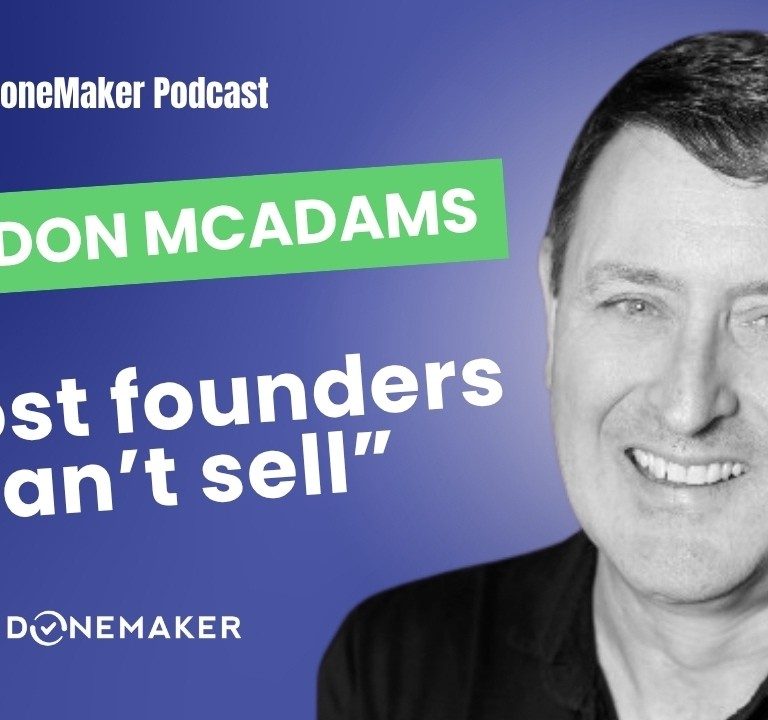
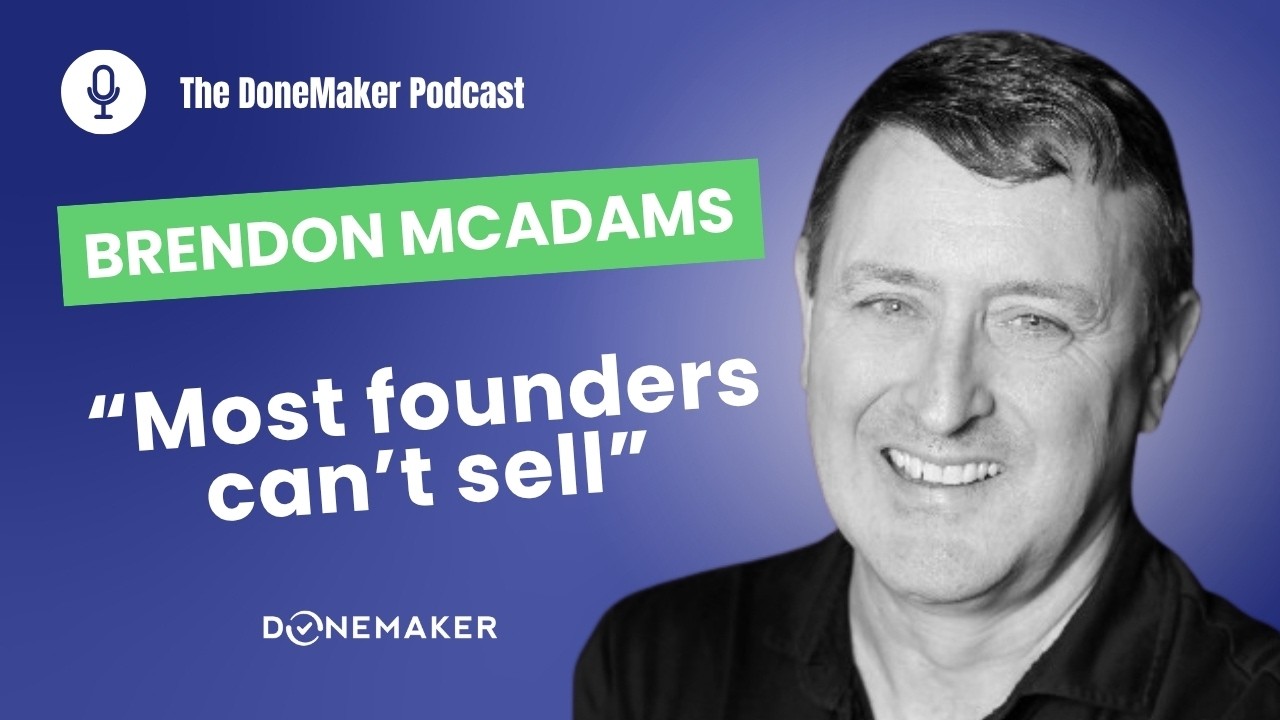
If you watched the DoneMaker interview with Brendan McAdams, you already know the conversation is full of clear, no-nonsense advice about how founders should approach B2B Sales. In this article I break down Brendan’s most actionable ideas and translate them into a step-by-step playbook you can apply right away. You’ll learn how to turn early conversations into paying customers, how to price based on value, how to coach reps to run discovery calls like trusted advisors, and how to build a sales pipeline that actually scales.
You will read practical guidance for every stage of the founder-led B2B Sales journey: from the first customer conversations (before you build) through qualification, discovery, pricing, follow-up, and handoff to reps or marketing. I’ll also include exact phrasing you can use on calls, a recommended end-of-call checklist to avoid ghosting, and a simple framework for turning early adopters into your best references. This is written in the same plainspoken, consultative voice Brendan used: direct, pragmatic, and focused on reducing risk for buyers.
“Don’t watch the clock. Do what it does. Keep going.”
1. Stop building in isolation — start with conversations (the founder’s pivot)
The first fatal mistake most founders make in B2B Sales is building before validating. You may have an elegant product or an AI prototype, but if you skip deep customer conversations you’ll miss the nuances of how your solution actually fits into someone else’s organizational process.
Here’s what you should do instead: before you code, before you finalize the spec, go talk to at least a dozen potential customers. Ask one simple framing question: “I’m working on this idea — here’s the problem I think it solves. How do you handle this today?”
Two outcomes are common and both are valuable. Either they say “that’s not a problem” (and you saved months of building the wrong thing), or they say “that is a problem — but you’re thinking about it wrong,” and they actually point you toward a real opportunity. Brendan used the example of Slack—products often pivot because early conversations reveal better use cases.
Practical steps for founders right now:
- Schedule ten short calls with people in your target industry. Don’t sell—ask and listen.
- Document exact language they use to describe the problem and outcomes they care about.
- Ask the money question early: “Would you pay for this? How much?”—it forces clarity on value.
- Iterate your concept with customers as co-designers—give them permission to annotate mockups or flows.
If you put these conversations at the beginning of your product roadmap, you turn B2B Sales into a discovery process that de-risks product decisions and generates your first real buyers.
2. Use early adopters as traction engines (case studies, references, and the risk reducer)
In B2B Sales the single biggest barrier to a new buyer is risk. Buyers worry about implementation failure, wasted budget, and career exposure if a pilot flops. The fastest way to reduce that perceived risk is to have credible early adopters who will vouch for you.
Turn the people you interviewed or piloted with into formal early adopters. Instead of treating them as one-off testers, ask for three things:
- Permission to use them as a reference.
- A short case study or metrics you can quote (even anonymous numbers help).
- Introductions to two prospects in their network who would benefit.
Those three things create a flywheel for B2B Sales: references reduce perceived risk, case studies give marketing ammunition, and introductions create warm leads. Brendan framed this as part of a broader marketing and sales handoff: “If you got those early adopters and they’re willing to be testimonials and references and do case studies and provide metrics, then you’re headed somewhere.” That’s the core of repeatable B2B Sales growth.
How to ask for references without sounding needy:
- After a successful pilot, say: “We want to help similar companies. Would you be open to a short case study or a peer-to-peer chat?”
- Offer to draft the case study and get their approval—don’t make it a time sink for busy buyers.
- Frame the ask as reciprocity: “If you introduce us, we’ll create metrics and collateral that show the impact to use in your investor or board updates.”
3. Price based on value, not cost—calculate the economic upside
Pricing in B2B Sales is a value conversation, not a commodity comparison. Instead of benchmarking against competitors or guessing at what the market will accept, translate your product’s impact into dollars and time saved for the buyer.
Ask this question on discovery: “If this solved your X problem, what would that be worth to you annually?” Then dig into specifics: does your solution reduce production cost by 10%? Improve conversion rate? Lower churn? Estimate the financial impact and capture a defensible share of that value.
Practical pricing framework:
- Calculate the buyer’s baseline costs or revenue related to the problem you solve.
- Estimate the percentage improvement your product delivers and convert to dollars.
- Price as a share of the captured value (e.g., 10–30% of annualized savings or revenue uplift).
- Offer pilot pricing or risk-sharing models when buyers are unsure about ROI.
Example phrasing: “If we could reduce your manual processing by 20% and that saves you $200k this year, we typically price our solution at 10–20% of that value depending on scope. Does that make sense?” You’ll be surprised how quickly a buyer engages when you talk impact, not features.
4. Train reps to act like consultants—mindset beats scripts in discovery
When you bring reps into your B2B Sales motion, the single most important shift is mindset. Teach them to be trusted advisors, not reciters of feature lists or tick-box interrogators. Brendan emphasized that “nobody wants to be sold to” and that buyers are trying to figure out whether you’re competent, motivated, and worth working with.
Here’s a practical discovery call template you can use to train reps to be consultative:
- Build rapport (2–3 minutes): simple, human, not transactional.
- Context: “Tell me about the business problem you’re working on” (open questions).
- Impact: quantify the current costs or missed opportunity.
- Stakeholders: identify who else must weigh in, who benefits, and who resists.
- Constraints: timing, budget, integration, or behavior change questions.
- Wrap: summary + explicit next steps and a mutual confirmation of fit.
Two coaching points for managers:
- Replace scripting with frameworks—give reps question flows and outcomes, not word-for-word lines.
- Practice role-plays where the buyer is defensive. Teach reps to slow down and explain why they’re asking specific questions (context reduces perceived intrusion).
When a rep says, “Do we have all decision makers on the call?” within the first minute, buyers feel like they’re being interrogated. Instead coach a different script: “I ask a few practical questions so I can quickly tell you whether we’d be worth your time—does that sound fair?” That simple prefacing line gives permission and changes the tone of the call.
5. End every call with a prescriptive, low-risk next step to avoid ghosting
Most deals die not because the product sucks but because follow-up fails. You avoid ghosting by planning the end of every call. Brendan recommends reserving the last several minutes of a call to summarize, confirm, and prescribe a concrete next step.
A repeatable end-of-call checklist for every B2B Sales conversation:
- Summarize what you heard (2–3 sentences).
- State the value you believe you can deliver.
- List the concrete action items (who does what by when).
- Confirm whether the buyer sees a reason to move forward.
- Get commitment on next contact and deliverables (not vague “we’ll follow up”).
Example closing phrasing:
“So here’s what I understand—you’re trying to reduce X by Y, and the constraints are A and B. If you think this makes sense, here’s how we usually proceed: 1) we’ll run a two-week pilot, 2) you’ll provide a headshot and profile data, 3) we’ll deliver an initial report. Can you commit to providing the data by next Tuesday?”
If the buyer hesitates or cannot commit to the action items, that’s a valid quick no—or a cue to diagnose the objection. Brendan is blunt: “A quick no is just as good as a yes.” You want clarity in your pipeline, not wishful thinking.
6. Prescribe the customer journey—but let the buyer own the decision
Being prescriptive doesn’t mean being pushy. Prescriptive selling means laying out a simple, transparent customer journey so the buyer knows what to expect. That reduces uncertainty and increases the perceived safety of making a buying decision in B2B Sales.
When you explain the steps—pilot, integration, metrics review—you remove the mysterious unknowns that make stakeholders nervous. Examples of the type of prescriptive language you should use:
- “If this makes sense, we typically do a 30-day pilot. During that time we’ll need X, Y, Z from your team and deliver A, B, C.”
- “Implementation usually takes three weeks because of these technical dependencies—if you need it faster we can compress the timeline for an added fee.”
- “At the end of the pilot we’ll present a simple ROI model you can show to finance.”
Be transparent about the costs and human work required. If someone cannot or will not commit to the required inputs, treat it as a disqualifier. You can still be helpful—point them to alternatives, referrals, or resources—but don’t let uncommitted prospects clog your B2B Sales pipeline.
7. Build a repeatable pipeline: collect language, testimonials, and role-specific messaging
A sustainable B2B Sales pipeline is not a magic trick—it’s a system built from repeated, consistent behaviors. The marketing team can’t create product-market fit; your early B2B Sales conversations do. The job of sales early on is to produce ammunition for marketing so outreach scales.
Here’s a short playbook that turns your first customers into scalable pipeline inputs:
- Collect customer language during discovery—how do they describe the problem and what outcomes do they care about?
- Create one-page case studies and short testimonials that address different stakeholders (IT, finance, operations, CEO).
- For each stakeholder create a short messaging block: chief pain, one metric, recommended next step.
- Hand these to marketing with target lists so ads, LinkedIn outreach, and content map to the audience language.
Brendan emphasized how messaging must change by stakeholder: “Can I get the words out of the mouth of someone in IT about the value of this solution? Then I get a different set of words from production, from finance, from the CEO.” When you do that consistently, your B2B Sales process moves from founder-led scrappiness to a repeatable machine.
8. Practical tools, templates, and phrases to use now
Below are tangible things you can use on your next calls to make B2B Sales clearer and faster:
- Pre-question preface: “I’m going to ask a few questions so I can quickly determine whether this is a fit—does that sound okay?”
- End-of-call summary: “Here’s what I understand. These are the three action items. Can you do X by Y date?”
- Value-pricing opener: “If we reduce X by 20% and that saves $Y, we typically price at 10–20% of that value.”
- Reference ask: “Would you be comfortable taking a 20-minute call with a peer so they can hear about your results?”
- Quick disqualifier: “It sounds like you’re not quite ready to move forward right now—would you like me to follow up in three months?”
These scripts keep calls consultative, reduce friction, and protect your pipeline from long, ambiguous opportunities that never close. Use them, practice them in role-plays, and evolve them as you learn what works for your ideal buyer.
9. When to use (and when to avoid) PowerPoint in B2B Sales
Brendan isn’t a big fan of over-reliance on PowerPoint. Slides can narrow imagination and turn a conversational discovery into a passive pitch. Use slides sparingly and for the right reasons:
- Use slides to explain complex flows, integration architecture, or dashboards.
- Use rough mockups as interactive artifacts during co-design sessions—not polished decks sent once and forgotten.
- Prototype proposals and anchor pricing with placeholders, then iterate with the buyer.
PowerPoints are valuable when they’re living documents you iterate with the buyer. Print them, mark them up in-person, and return with a new version. That process creates ownership and accelerates B2B Sales decisions.
10. Final thoughts — make B2B Sales part of your product process
B2B Sales isn’t an isolated function. When you treat sales as an extension of product discovery, you dramatically increase the chance that what you build actually solves a real problem and that buyers will pay for it. Brendan’s core prescriptions—talk before you build, convert early conversations into references, price on value, train reps to be trusted advisors, and end calls with prescriptive next steps—are all about reducing the buyer’s risk.
Two simple actions to start today:
- Schedule ten discovery calls with real potential buyers and treat them as co-designers. Capture their exact language and a willingness-to-pay response.
- Create one short case study from a pilot or early adopter and use it in a targeted outreach campaign for stakeholders who will make or block the decision.
If you want to go deeper, Brendan’s ideas are condensed in his new short-format book, which is deliberately designed for founders and early teams who want fast, actionable guidance on getting traction. You can also connect directly with folks who run these experiments daily—LinkedIn is a great place to start building your network and getting real buyers on the phone.
Remember: in B2B Sales you’re selling reduced risk and improved outcomes. Speak to those two things on every call, and you’ll convert more prospects into real, repeatable revenue.
Watch the full podcast here: Use this framework to make B2B sales repeatable as a founder – Brendon McAdams – DoneMaker Podcast
FAQ — Common questions about founder-led B2B Sales