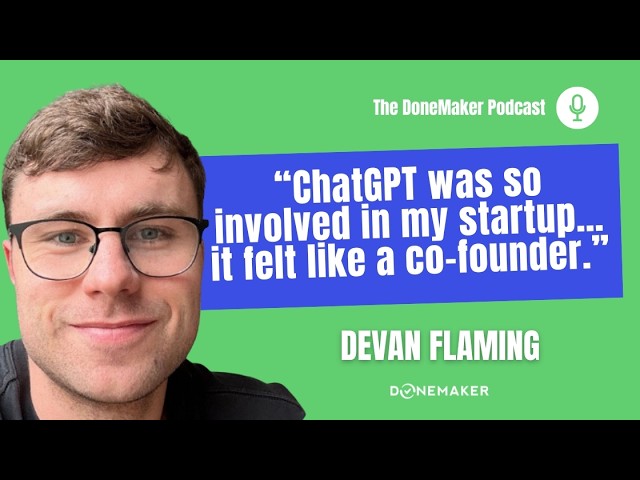
You’re about to read a practical, candid founder story that shows how AI can become your partner from naming a company to launching a live SaaS product. In a short conversation with DoneMaker, Devan Flaming, founder of SourceIt, explains how he used AI, ChatGPT, and no-code platforms to take a content-creation hobby on TikTok and transform it into a product for businesses. This article breaks down that journey into ten actionable lessons you can use if you want AI to accelerate your own startup path.
1. Treat AI as a co-founder: start with the name, tagline, and positioning
When you begin, you often underestimate how many tiny decisions a startup needs: the company name, the tagline, the initial positioning. Devan leaned on AI for those exact tasks. He didn’t just ask for name ideas once — he iterated with ChatGPT and refined options until he landed on SourceIt. If you’re starting, this is the first place AI helps you move fast without analysis paralysis.
How you can apply it:
- Ask AI for 20 name variations tied to your value proposition, then request taglines and short elevator pitches.
- Use AI to produce quick A/B copy variations you can test on landing pages or with friends.
AI appears throughout this process as both an ideation engine and a filter. You’ll get options faster, and you’ll find iteration cycles become shorter. Use AI to brainstorm, then apply your human judgment to decide what resonates most with your target audience.
2. Use your hobby as user research — the product begins with what you already do
You probably already create content, sell something, or perform a craft that could be productized. Devan’s origin story started with TikTok videos about fitness and CPG products. Because he was already making content, he saw the opportunity: employees creating videos in store or at work are a huge untapped channel for authentic marketing.
For you, the lesson is simple: start from what you know. If you’re a user of a workflow, you know the pain points. You understand the language. That informs everything — from AI prompts to early landing page copy.
When you combine your lived experience with AI-driven idea generation, you close the gap between inspiration and execution. AI speeds brainstorming, you provide domain knowledge, and the product idea becomes concrete.
3. Validate assumptions: the biggest hurdle might be human behavior, not technology
One surprise Devan faced was that companies liked the idea in theory but hesitated to adopt employee-generated content. The largest barrier was cultural: getting employees comfortable creating content and convincing older stakeholders that employee videos can be brand-safe and effective.
This is a critical reminder: AI will help you build an offering quickly, but human behavior and organizational change require different plays. When you’re validating, inspect behavior signals (downloads, submissions, participation rates) rather than simple interest.
Practical steps:
- Pilot with a small group first to collect real behavior metrics.
- Use AI to craft onboarding scripts, challenge prompts, and micro-incentives that lower the activation friction for employees.
- Record case-study metrics early (downloads, submissions) so you can iterate with data.
4. Start with the easiest no-code tool, then scale up to more capable platforms
You don’t need to pick the perfect tech at day one. Devan started on Glide — an extremely beginner-friendly no-code tool — then moved to FlutterFlow when he needed more power. Your goal early on is to learn product constraints quickly and discover what capability you’ll actually need.
How AI helps here:
- Use AI to compare platforms based on your feature list: ask for pros/cons of Glide, Bubble, FlutterFlow, and others for your specific use case.
- Ask AI to generate a migration checklist if you plan to move from one platform to another.
Don’t be afraid to try multiple platforms. The ramp-up time is small compared to the learning you’ll gain about feasibility and trade-offs. AI can accelerate your platform learning by giving you step-by-step instructions to build small features.
5. Learn by doing with AI: screenshots, prompts, and iterative fixes
Devan used AI in a highly practical way: take a screenshot, ask ChatGPT what’s wrong, paste component properties, and request step-by-step fixes. This is not high-level handwaving — it’s a hands-on, iterative approach where AI functions as an interactive manual and tester.
Why this works:
- It dramatically shortens the trial-and-error loop on no-code platforms.
- AI can suggest specific configuration changes instead of abstract advice.
- You learn the platform faster and reduce dependence on external developers for small tasks.
Be realistic: AI won’t replace everything. Devan described getting to a “half MVP” on his own (about four to six months) before outsourcing development to finish the product. AI helps you bootstrap, but complex or production-scale features may still require human developers.
6. Understand where no-code tools shine: and where they hit limits
No-code and AI together create extraordinary velocity, but there are trade-offs. You can build a functional app fast. However, complex business logic, edge-case workflows, and deeply-customized integrations can break the simplicity of no-code.
When to stay no-code:
- Proof of concept features with straightforward UI/UX
- Internal tools or pilot projects that don’t demand scale immediately
When to consider code:
- Complex “if-this-then-that” rules that must run reliably at scale
- Custom integrations with legacy systems or intricate subscriptions/rating logic
Use AI to help you map where those limits are. Ask AI to draft a capability matrix comparing what you can and cannot do with a chosen no-code tool. That clarity will save time and avoid a painful refactor later.
7. Hire strategically — cheap is rarely the fastest path to success
When you move past a half-built MVP and decide to bring in a developer, your hiring decisions matter. Devan learned that the cheapest developer isn’t always the best option. Pay a bit more for someone who understands your vision, communicates well, and can translate product goals into code or no-code implementations.
Hiring tips:
- Prioritize alignment: find someone who believes in the product and can suggest improvements.
- Use AI to screen candidates: craft interview questions, skill tests, and sample projects.
- Ask for references and sample work that shows both technical ability and product thinking.

When the team understands the vision, development flows faster because you don’t lose time clarifying requirements. AI can help you prep for meetings and produce clear spec documents that speed up the dev process.
8. Test with actual users early — collect behavior metrics, not just opinions
One company pilot gave SourceIt a 17% app download rate among employees and five submitted pieces of content. That’s encouraging, but Devan wants higher engagement, so he’s iterating. Your pilots should prioritize measurable outcomes over compliments.
Metrics to track in early pilots:
- Download rate among invited employees
- Activation events (first content submission)
- Retention (repeat content creators, daily/weekly active users)
- Quality metrics (shares, likes, conversions from employee posts)
AI can help you design pilot experiments and predict the sample size you need to reach statistical significance. Use AI to build onboarding text, challenge templates, and reward language that lifts conversion rates.
9. Mix founder-led marketing with AI-driven content — LinkedIn matters
Devan leaned into founder-led marketing and LinkedIn outreach. In 2025, building an audience is among the fastest ways to shorten sales cycles for B2B products. You probably need a combination of content, outreach, and email to convert prospects.
How AI helps your go-to-market:
- Generate LinkedIn post ideas that position you as an expert without sounding robotic.
- Create personalized outreach templates for LinkedIn messages and follow-ups.
- Produce email subject lines and cold email sequences you can A/B test.
Don’t forget that relationships matter. Devan mixes in-person sales, LinkedIn outreach, and warm leads from existing relationships. AI speeds your content and outreach, but you still need real conversations to close pilots and get case studies.
10. Build case studies and iterate the ICP — one niche at a time
At this stage, Devan is focused on collecting success stories. That’s the single most effective growth lever for an early SaaS: credible case studies that show measurable outcomes. Once you have a few wins, iterate toward the ICP (ideal customer profile) that produces the best ROI.
How to use AI here:
- Ask AI to draft case study templates and questions to ask pilot customers.
- Use AI to write landing pages, sales decks, and customer-facing reports based on pilot data.
- Have AI help you identify industry clusters where your metric lift is highest.
Once you identify that ICP, focus your messaging and features for that niche. Niching reduces friction in sales, shortens cycles, and improves conversion rates. AI helps you scale writing and documentation so you can personalize messaging faster.
11. FAQ — Practical answers about AI, no-code, and launching
Q: Can AI build a full product for you?
A: AI accelerates nearly every step: ideation, naming, copywriting, platform guidance, and even generating code snippets for some no-code tools. However, in most real-world cases you’ll use AI to reach a “half MVP” quickly, then bring on a developer to finish and harden the product for scale.
Q: How long will it take to get to a half MVP?
A: Based on this example, expect around four to six months to get to a functioning half MVP if you’re learning the no-code tool and iterating with AI. If you already know a platform, that timeline compresses. Use AI to create checklists, timelines, and feature backlogs to accelerate your path.
Q: What’s the role of no-code platforms when AI is involved?
A: No-code platforms let you realize ideas quickly; AI helps you learn and troubleshoot those platforms faster. Together, they dramatically lower the barrier to building product prototypes. But be mindful of platform limitations that may force a migration later.
Q: How many AI mentions are too many when writing product copy?
A: For your product messaging, avoid overusing the term “AI.” Frame AI as a tool that improves outcomes (speed, personalization, automation), but focus messaging on the real benefits users receive — time savings, higher content volume, or measurable engagement uplift.
Q: Does founder outreach still work in a world full of AI?
A: Absolutely. AI helps you scale outreach and personalize messages, but trust-building happens in human conversations. Combine AI-crafted messaging with founder-to-founder outreach to close pilots and secure case studies.

These FAQs pull together the pragmatic parts of the journey. AI is a force multiplier — but it’s not a replacement for human judgment, sales chops, or product vision.
Final notes — practical checklist to apply right now
If you want to act on this story and use AI the way Devan did, start with this short checklist you can follow today. Each step is a concrete action where AI speeds progress:
- Use AI to generate 20 name and tagline combinations and pick three to test with friends and potential users.
- Create a one-page spec for your product and ask AI to produce a prioritized feature backlog.
- Select an easy no-code platform and follow an AI-generated walkthrough to build a core flow.
- Take screenshots of your work, paste them into AI prompts, and ask for step-by-step fixes.
- Run a small pilot with a handful of users and track behavior metrics (downloads, submissions, retention).
- Prepare a case-study template and have AI draft a write-up from pilot metrics.
- Do LinkedIn outreach using AI-crafted messages, but personalize them before sending.
- Hire a developer only when you’ve validated the core use case; use AI to prepare technical specs for that hire.
- Iterate toward a single ICP that shows the best traction, then scale messaging and outreach for that niche.
- Collect success stories and create a slim sales kit using AI to scale content production.
AI will appear at each step as a helper for writing, ideation, platform learning, and rapid iteration. Remember that the human steps — talking to customers, hiring aligned talent, and shaping product vision — remain the differentiators that will make your product endure.
Quote to remember: “I really treated AI as my co-founder for the product.” — this mindset is not about handing off responsibility; it’s about using AI to amplify your execution so you can focus on relationships, product-market fit, and storytelling.
If you follow this roadmap, you’ll find AI reduces friction, no-code gives you speed, and targeted human effort secures traction. That combination is how a hobby—like creating TikTok content—can become a live SaaS product in a matter of months.

Now it’s your turn. Use AI to get unstuck, pick a simple platform to prototype, and start small. Build trust with real users, iterate your ICP, and collect the kind of case studies that turn pilot enthusiasm into paying customers.
Watch the full podcast here: The SECRET to Turning a Hobby into a business with AI in weeks.