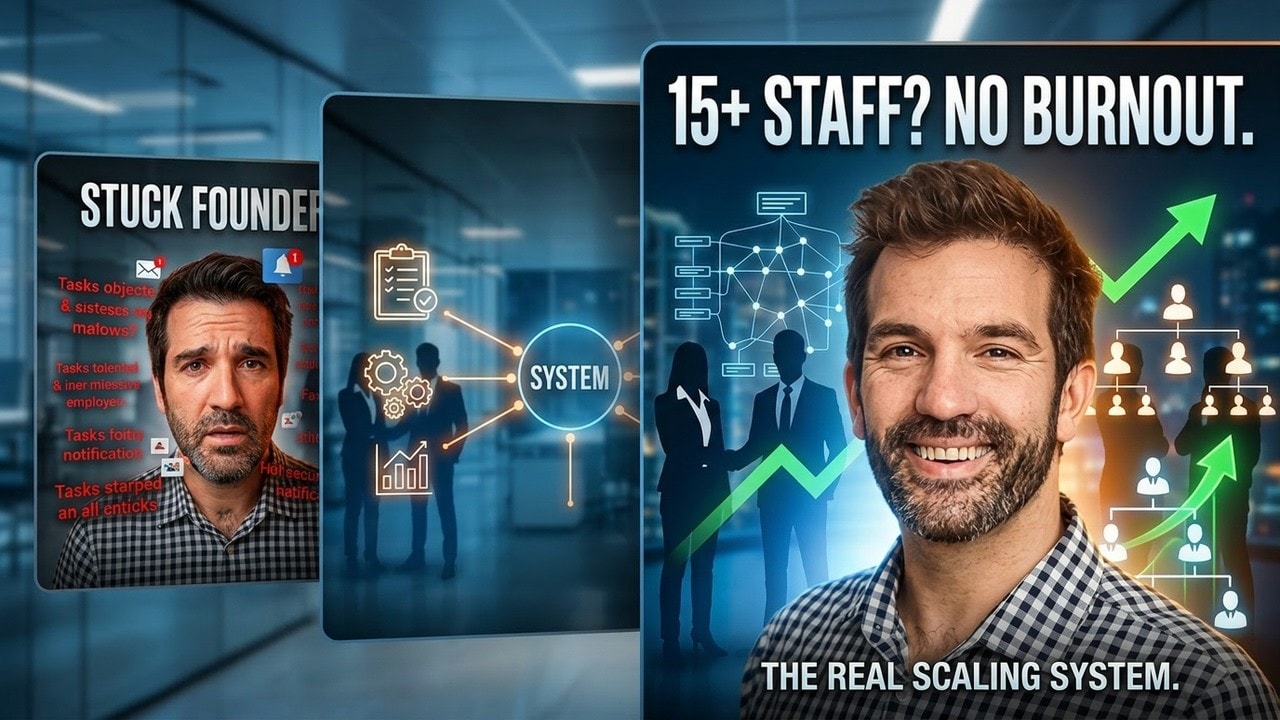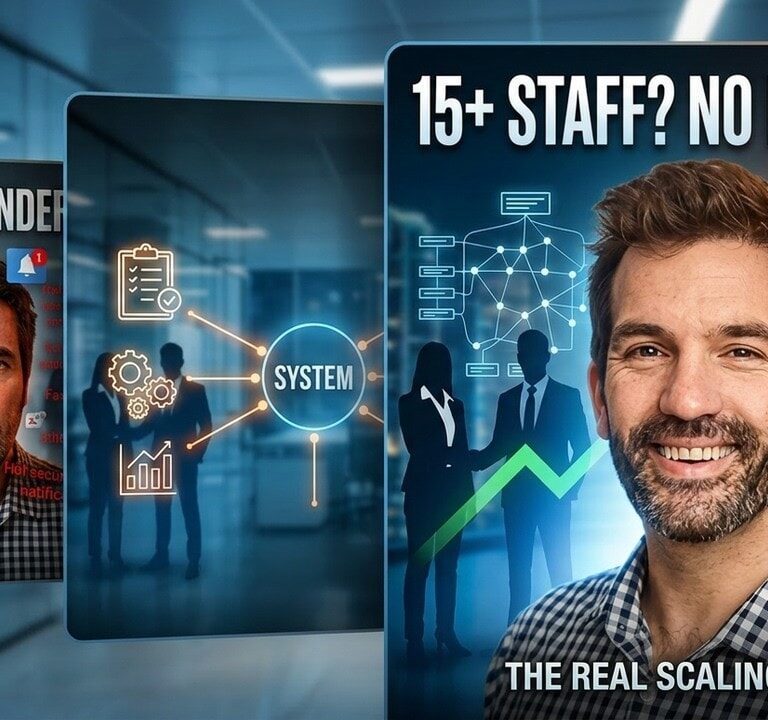
Scaling an agency sounds glamorous right up until every decision runs through you, every client problem lands on your desk, and every new hire seems to create as many questions as they solve.
That is the turning point Erik Rubadeau hit while building YeeBoo Digital, a digital marketing and technology agency focused on non-profits. What started in classic startup mode with lots of yeses, fast reactions, and everyone doing a bit of everything eventually reached the point where hustle alone stopped working. The answer was not more grind. It was structure, process, better hiring, and a completely different understanding of what the CEO job actually is.
This story is especially useful for agency owners, small business operators, and founders who are stuck between two worlds. You are no longer tiny, but you are not yet so big that you can hide bad systems behind headcount. That middle stage is where chaos gets expensive.
What makes this approach so refreshing is that it is grounded in reality. No inflated leadership theory. No fantasy org chart. Just practical lessons on how to build a team, avoid burnout, use AI intelligently, and stop being the person who has to touch everything.
Table of Contents
- YeeBoo Digital’s niche made process impossible to ignore
- Startup mode works until it really, really doesn’t
- The exact hiring shift that unlocked growth
- Why culture fit beat credentials every time
- The expensive recruiting lesson most founders learn too late
- How to avoid the sink-or-swim management trap
- What the company learned about AI before most businesses did
- Where AI actually created value inside the agency
- Why WordPress still wins for many organizations
- The founder-to-CEO shift is less glamorous than people think
- What a CEO should not let go of too early
- A practical framework for founders scaling from 5 to 15 people
- One underrated idea: the process often matters more than the tool
- FAQ
YeeBoo Digital’s niche made process impossible to ignore
YeeBoo Digital helps non-profits grow revenue through digital marketing, websites, technology implementation, and support services. That means helping organizations use websites, donation platforms, email tools, SMS, advocacy platforms, and digital campaigns to strengthen fundraising and deepen relationships with supporters.
That niche matters because non-profit marketing is different from traditional for-profit marketing in a big way. Most companies are selling a product. Non-profits are usually inviting people to support change, participate in a mission, and feel that they are doing the right thing. There is often no physical object at the end of the transaction. The “offer” is emotional, mission-driven, and trust-based.
That creates a more complex marketing environment. You are not just selling features. You are telling stories. You are creating a multi-channel donor experience. You are helping people connect with an organization’s purpose over time.
This is one reason agencies in that space cannot rely on random execution. They need systems. They need consistency. They need a process that can survive internal turnover, shifting donor expectations, and increasingly fragmented channels.
And that same principle applies inside the agency too.
Startup mode works until it really, really doesn’t
In the beginning, the early hiring decisions were simple. They were driven by immediate need.
Like many founders, Erik could do a lot. He was technical enough to build, strategic enough to see opportunities, and adaptable enough to figure things out on the fly. He described himself as someone who can get almost any plate spinning, while also being self-aware enough to know he is not the best long-term plate spinner for all of them.
That combination is powerful in the early stage. It helps a business get off the ground. It also creates a trap.
When the founder can do sales, delivery, technical work, design thinking, and client problem solving, the company tends to grow around that person’s flexibility. The first hires often become “unicorn generalists” too. They do a bit of everything. They mirror the founder. Everyone is reacting. Everyone is helpful. Everyone is busy.
That setup can get a company surprisingly far.
But around 4 or 5 people, something changes. The cost of saying yes to everything gets much higher. Every new project starts competing with another. Priorities blur. Communication becomes fuzzier. Work quality starts depending on who remembered what, not on a reliable operating system.
“We need structure. We need process.”
That realization is one of the most important moments in any growing agency. It signals the shift from startup energy to company-building discipline.
The exact hiring shift that unlocked growth
The most important move came when the business was in that 5 to 10 person zone. That is when Erik brought in someone to give shape to project management and operations.
That hire became a major lever. Over time, that person rose through the company and became president and COO.
This was not just another employee. It was the beginning of managerial structure.
Why did this matter so much?
- Projects needed ownership. Work could no longer float between people informally.
- Client delivery needed consistency. Great work once is not enough. Agencies need repeatable quality.
- The founder needed a counterbalance. Big-picture thinking needs someone who can operationalize details.
- Growth required prioritization. The team had to stop accepting everything without considering tradeoffs.
That last point is huge. In startup mode, yes is exciting. As you grow, yes without structure becomes expensive. Every commitment carries an opportunity cost. If the business does not decide intentionally what to take on, it starts sacrificing quality, morale, or both.
So if you are wondering about hiring order, the lesson is not “copy this exact org chart.” The lesson is sharper than that:
- Hire first for urgent capability gaps.
- Then hire for the founder’s weaknesses and capacity limits.
- Then, before chaos compounds, bring in operational structure.
That is the transition that helps an agency move from survival mode to sustainable growth.
Why culture fit beat credentials every time
One of the clearest themes in Erik’s hiring philosophy is that skills matter, but personality, hunger, and fit matter more.
He was blunt about what can and cannot be taught.
You can teach a person how to use your sector-specific tools. You can teach internal workflows. You can coach people through processes and standards.
What you cannot easily teach is:
- care
- respect
- resilience
- ownership
- the willingness to get back up after failure
That is why he consistently hired for personality and fit first. Not because expertise is irrelevant, but because in a smaller agency, one bad fit does not stay isolated. It affects everyone.
Culture in a sub-20-person business is not a slogan on a wall. It is the lived experience of how people handle pressure, help one another, communicate with clients, and respond when things go sideways.
This is particularly important in client-facing and leadership roles. Those jobs amplify behavior. Someone who shuts down in tense moments, avoids accountability, or creates friction can do damage far beyond their technical output.
The smarter approach is to ask:
- Does this person genuinely want the work?
- Do they respond well under pressure?
- Are they teachable?
- Do they care about doing things well?
- Will other people enjoy solving problems with them?
That is not soft hiring. That is strategic hiring.
The expensive recruiting lesson most founders learn too late
At one point, the company tried using a recruiter. It only happened once.
The result was underwhelming across the board. It cost a lot of money, and the hire did not last beyond the warranty period tied to the recruiting engagement.
That failure reinforced an important insight: outside recruiters may be good at filling roles, but they do not automatically understand the culture, chemistry, and nuances that make a small agency team work.
For YeeBoo Digital, hiring had to remain highly personal and highly contextual. Their best results came from an organic, iterative process that focused on understanding motivations, working style, and fit with the company’s values.
This is especially relevant for founders who feel insecure about hiring. There is often an assumption that a “professional” system must be better than the founder’s own instincts.
But founders often know more than they think.
Yes, there is imposter syndrome. Yes, hiring can feel awkward when you are still figuring out the role yourself. But if your business has a specific culture, a unique service model, and a team dynamic you care deeply about, your hiring process should reflect that.
The right candidate on paper is not always the right person in practice.
How to avoid the sink-or-swim management trap
One of the most valuable leadership ideas here came from contrast.
Erik had previously worked in an agency environment that was very much sink or swim. People were thrown in, expected to perform, and left to figure it out. Some did. Some became extremely strong. But many simply drowned.
That experience shaped how he built his own company.
He did not want an environment where people were abandoned. But he also knew the opposite extreme was not healthy either. Leaders cannot do everyone’s jobs for them. Constant rescuing creates dependency, slows the organization down, and prevents growth.
The real challenge is finding the balance:
- Give people enough room to own their work.
- Do not let them drift so far that they are struggling alone.
- Create support without creating helplessness.
That balance is harder than it sounds.
High-performing teams often contain people who are eager to solve problems themselves. That is great. It also means they may wait too long before asking for help. They bounce their heads off the wall trying to crack something when someone else on the team could save them an afternoon in ten minutes.
This creates a subtle management responsibility. Leaders need to normalize asking for help before frustration becomes waste.
A healthy culture is not one where everyone always figures it out alone. It is one where people try first, notice patterns, and raise a hand early enough to keep momentum.
What the company learned about AI before most businesses did
The conversation around AI was refreshingly grounded. No hype. No panic. No fantasy about replacing entire teams overnight.
The core idea was simple: what people call AI today is powerful, but it is inconsistent. It is probabilistic, not deterministic.
That distinction matters a lot.
Traditional software gives the same answer to the same inputs because it follows fixed logic. Current AI systems do not behave that way. They generate outputs based on probability, context, and patterns. That is why they can feel brilliant one minute and strangely unreliable the next.
Ask the same thing twice and you may get different answers. Push a long conversation far enough and it can start drifting. Use it for structured precision and it may still make silly errors. That is why treating it as flawless intelligence is dangerous.
At the same time, dismissing it would be a mistake.
Erik described it less as “intelligence” and more like a fantastic operating system. That framing is useful. It helps business owners think of AI as a new interface for solving problems, exploring possibilities, and speeding up ugly workflows, not as an all-knowing replacement for human judgment.
There was also a sharp point about adoption. New technologies are often first used to imitate the old world. Early television basically pointed cameras at people doing radio-style performance because that was the familiar model. Over time, people learned what the medium actually made possible.
The same thing is happening with AI right now. Many businesses are still using it to do old tasks slightly faster. The bigger opportunity is rethinking workflows entirely.
Where AI actually created value inside the agency
Inside YeeBoo Digital, AI was not introduced as a headcount replacement strategy. It was introduced as a workflow improvement strategy.
That is a major difference.
The internal question was not, “Who can we replace?” It was, “What process sucks, matters, and consumes too much valuable time?”
That framing led to one of the best examples in the whole conversation.
When the agency builds WordPress sites or implements new tools for clients, they create custom documentation and training materials. This is especially important in the non-profit world, where staff turnover is high. The person trained today may not be there a year from now. So the agency creates step-by-step guides with screenshots showing exactly how to update content, manage pages, and navigate the client’s backend system.
That documentation work is useful. It is also incredibly time-consuming.
Project managers were spending days clicking through processes, taking screenshots, typing instructions, and assembling manuals.
Then a team member found a tool that could capture clicks, generate screenshots, and draft the documentation flow automatically while the user talked through the process.
The result was not perfect. There was cleanup involved. Some words were wrong. Some screenshots needed replacing.
But the time savings were massive. One estimate put the gain at about 20 hours on that task.
That is exactly how AI should be used in many service businesses:
- Remove repetitive manual drudgery.
- Preserve or improve the outcome.
- Free up talented people for higher-value work.
It is hard to argue with that. No one wakes up excited to spend three days screenshotting a backend. But plenty of smart people would rather spend that time on strategy, creative thinking, problem solving, or client guidance.
That is not dehumanizing work. That is humanizing work.
Why WordPress still wins for many organizations
Another practical takeaway came from website technology.
YeeBoo Digital doubled down on WordPress after years of touching other content management systems like Joomla and Drupal. That decision was not based on trendiness. It was based on usability, maintainability, and the realities of hiring.
In the non-profit sector, turnover can be high. That means websites need to be manageable by whoever comes next, not just by the original builder or a deeply technical specialist.
WordPress remains powerful in that context because:
- Its admin experience is familiar to many people.
- Creating pages and posts is relatively accessible.
- Future hiring is easier because many candidates already know the basics.
- Switching agencies or developers later is less painful because the talent pool is broad.
This is such an important business lesson. The best tech stack is not the one that looks coolest today. It is the one your team and future team can realistically operate.
That is also why AI-built websites do not automatically solve the real problem. Building something quickly is not the same as building something that fits organizational priorities, gets stakeholder buy-in, and remains manageable over time.
In website projects, the true value often lives in discovery, alignment, prioritization, and decision-making, not just in code production.
Anyone can say they want their department featured above the fold. The hard part is guiding an organization toward the choices that actually serve users and business goals.
The founder-to-CEO shift is less glamorous than people think
One of the most honest parts of the conversation was what happened after Erik stepped out of day-to-day tactical work.
At first, there was an identity gap.
If you have spent years being deeply hands-on, the move into a CEO role can feel weirdly empty. Everyone else appears busy. Work is happening. Problems are being solved. And suddenly you are not in the middle of all of it.
That can trigger a question many founders do not say out loud:
What exactly am I supposed to do now?
The answer did not arrive instantly. He described the transition as being a CEO in training for years. That is a useful expectation. This is not a switch you flip. It is a role you grow into.
A strong metaphor emerged from the conversation. Moving into the CEO role is like going from player to coach. Earlier, you are on the field making direct plays. Later, your influence becomes more indirect but often more important. You set up the conditions. You shape the team. You decide where energy goes. You study the field. You make sure the right people are in the right positions.
And later still, another metaphor took over. You built the boat. You filled it with capable sailors. Now your job is to figure out where the boat should go, who it should sail with, and what weather is coming.
That is a much better picture of CEO work than the typical “visionary leader” cliché. It is strategic, directional, and deeply tied to learning.
A CEO cannot stop learning. If anything, the learning has to increase. The founder no longer just needs to know how to do the work. They need to understand markets, timing, positioning, partnerships, risk, and the larger patterns affecting the business.
What a CEO should not let go of too early
Founders often ask what they should delegate first. That matters. But the better question might be what they should still hold onto.
For Erik, two areas remained close:
- Sales and relationships
- Brand core and spirit
Sales stayed because the company is deeply relationship-driven. The agency works with organizations for years, sometimes a decade or more. Those relationships are not just pipeline mechanics. They are trust assets. Handing them off casually would be like introducing a stranger into a long-standing personal relationship and expecting continuity.
This does not mean founders should never build a sales team. It means some relationships are strategic enough that the founder’s involvement still creates outsized value.
The second area was brand. Not every design decision. Not every visual asset. But the spirit of the company. The tone. The mission. The sense of who they are and how they do things.
This is a subtle but powerful leadership responsibility. In growing companies, brand can easily drift as more people contribute. Sometimes that is healthy. Sometimes it creates confusion. A founder who can preserve the core while still allowing the brand to evolve gives the company continuity.
A practical framework for founders scaling from 5 to 15 people
If you are in the messy middle of agency growth, here is the playbook that emerges from these lessons.
1. Stop glorifying reactive growth
Startup mode rewards speed and flexibility. But if every opportunity gets a yes, your team eventually pays for it. Growth without prioritization becomes chaos with better branding.
2. Hire for gaps first, then for structure
Your earliest hires may need to cover immediate capability needs. After that, look hard at your own bottlenecks. Then, before confusion compounds, hire someone who can build operational clarity.
3. Choose hunger over polish when fit matters more
In small teams, a person who cares deeply, learns fast, and handles pressure well often outperforms someone with a cleaner resume but weaker alignment.
4. Build support, not dependency
Avoid both extremes. Do not throw people overboard. Do not carry them forever either. Create a culture where people try, learn, ask, and grow.
5. Use AI on miserable workflows first
Find the repeatable work no one enjoys but everyone needs. That is where time savings become real without introducing reckless risk.
6. Keep the parts of the business where your presence compounds value
For some founders, that is sales. For others, brand, product, technical vision, or strategic partnerships. Do not let go of high-leverage areas just because generic advice says you should.
7. Redefine your job before burnout redefines it for you
The founder role and the CEO role are not the same. If you do not consciously change how you spend time, the business keeps pulling you back into low-leverage work.
One underrated idea: the process often matters more than the tool
There is one principle that stretches across everything here, from websites to AI to hiring.
The process often matters more than the tool.
A tool can generate a website. It cannot automatically create stakeholder alignment.
A recruiter can send candidates. That does not mean they understand your culture.
An AI assistant can produce output. That does not mean it can be trusted blindly.
The businesses that scale well are not the ones chasing tools as shortcuts. They are the ones designing strong processes around real constraints, real people, and real decisions.
That is what allowed YeeBoo Digital to grow without becoming founder-dependent forever.
And that is what many agency owners need to hear most. You do not need to stay trapped in the day-to-day to maintain quality. But you do need systems, judgment, and enough self-awareness to know what should leave your plate and what should stay in your hands.
If you want to learn more about Erik Rubadeau and his work, you can connect with him on LinkedIn or explore YeeBoo Digital.
FAQ
When should an agency founder stop hiring generalists and add more structure?
A key inflection point often appears around 5 to 10 employees. That is when reactive startup habits stop scaling well. At that stage, adding operational structure, especially through project management or a strong operator, can unlock the next phase of growth.
What should founders prioritize when hiring early team members?
Early hires should cover urgent capability gaps and reduce the founder’s biggest weaknesses or capacity constraints. Skills matter, but in smaller teams, personality, ownership, and hunger often matter even more because they shape culture and execution speed.
Why did using a recruiter not work well in this case?
The recruiting experience was expensive and did not produce a durable hire. The deeper lesson was that a small agency’s culture and working style are hard to outsource. A more personal, founder-led process was better at identifying fit, motivations, and long-term alignment.
How should agencies use AI without making costly mistakes?
The smartest starting point is to use AI for repetitive, frustrating, low-creativity tasks that still matter. Good examples include documentation, process capture, and workflow automation. It is much riskier to use AI blindly for high-stakes strategic or precision work where inconsistency can create major errors.
What tasks should a CEO hold onto as the company grows?
That depends on the founder, but high-leverage areas often include strategic relationships, sales, company direction, and the core spirit of the brand. These are the places where founder presence can still have an outsized impact even after daily execution is delegated.
What is the biggest mindset shift when moving from founder to CEO?
The shift is from doing the work to creating the conditions for great work to happen without you. That means moving from player to coach, and eventually from tactical contributor to strategist, navigator, and decision-maker about where the business should go next.