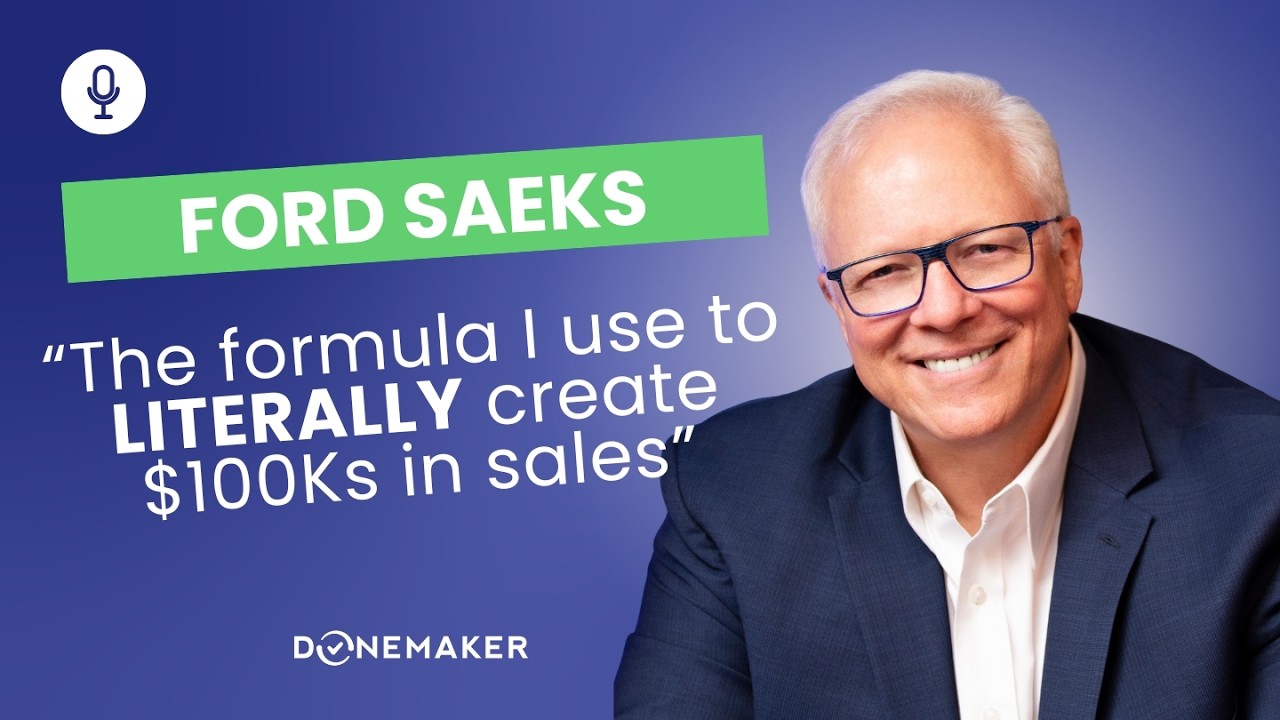
You watched a powerful conversation on the DoneMaker podcast with Ford Saeks, and now you’re here to turn that energy into action. In this article you’ll get a clear, pragmatic breakdown of the ideas Ford shared, the mental shifts, repeatable formulas, and AI strategies that actually move the needle. I’ll walk you through how to calibrate your Success Mindset, test what works, craft the message that converts, and use AI the smart way so you don’t waste time or money.
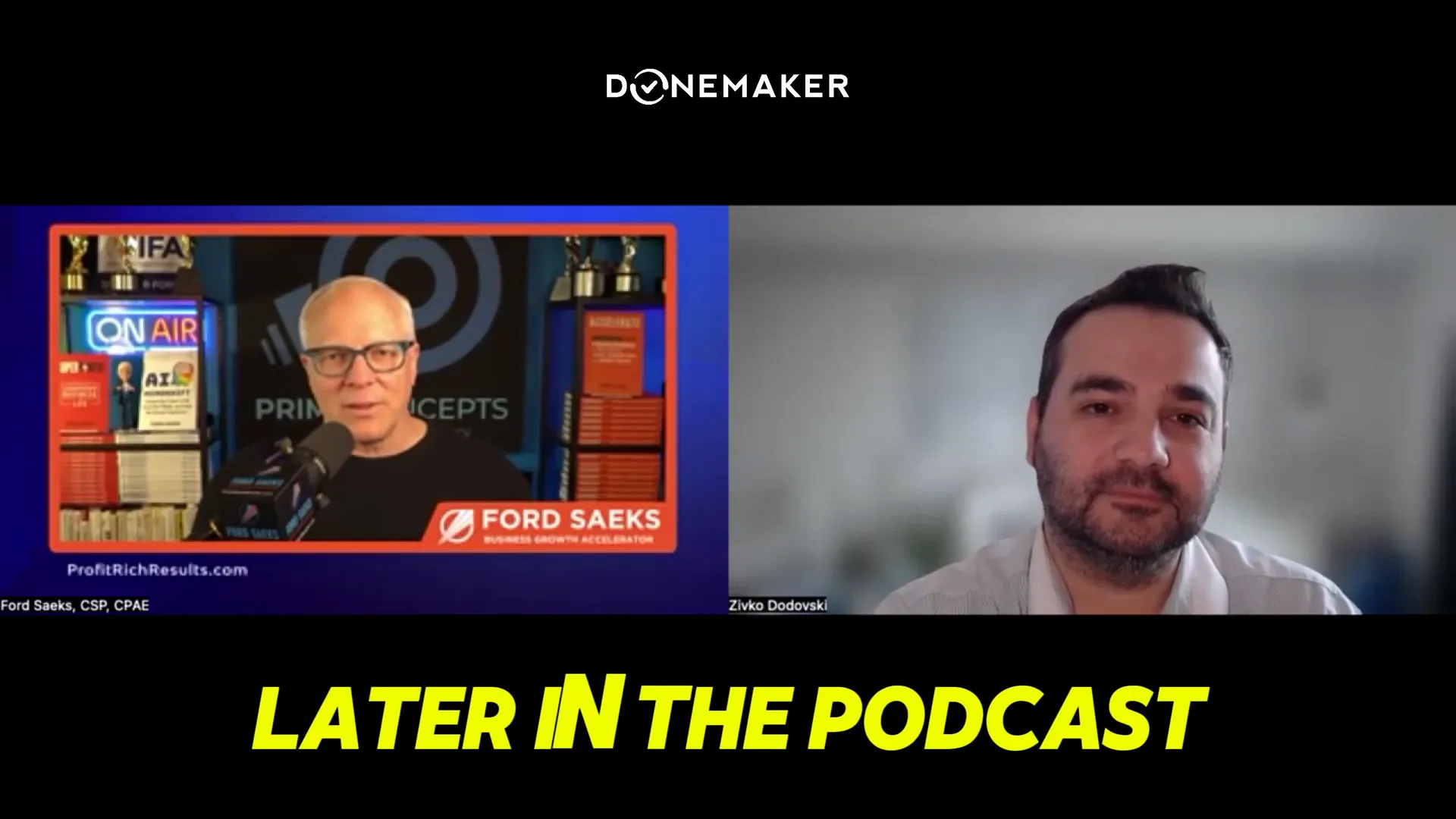
“It’s not what you know, it’s how well you execute.” That line frames everything Ford talks about. If you want to build momentum, your Success Mindset needs to be oriented toward execution and learning from action—not paralysis by perfection.
1. Calibrate your mindset before anything else
Ford makes one point repeatedly: the first thing you must get right is your mindset. If your head isn’t in the game, no strategy or tactic will deliver. For you, that means asking a few honest questions about how you show up every day.
- On a scale of 1–10, how would you rate your mindset right now?
- Are you more positive than negative? Are you coachable?
- Do you take ownership and use your time at the highest and best use?
What I want you to understand is that a Success Mindset is not motivational fluff. It is practical: it unlocks discipline, makes you coachable, and forces you to measure what matters. When you adopt that orientation, strategies and tactics suddenly become tools you can wield rather than distractions that fragment your attention.
Ford’s voice is direct: without mindset, the rest fails. He repeatedly emphasizes culture, leadership communication, and accountability for teams. If you are leading others, your Success Mindset is contagious — and if you’re getting coached, make sure you’re applying what you learn.
2. Use the Test → Track → Modify → Repeat formula
When you don’t know what’s working, you must test. Ford’s first formula is brutally simple and highly effective: test, track, modify, and repeat. Treat everything you do as an experiment: a video, a mailer, a webinar, a networking event.
How to apply it today:
- Run the test (publish the episode, run the ad, send the email).
- Track the results (views, replies, conversion rate, cost per lead).
- Modify one element (headline, CTA, audience, time-of-day).
- Repeat and compare against your baseline.
This process demands discipline and honesty. Ford stresses: be logical, not emotional, when you evaluate results. If you fail, learn the lesson and move on. The Success Mindset here is about embracing failure as data, not identity.
3. Lead with benefits — message matters more than features
One of the most useful frameworks Ford shared is the hierarchy inside every message: benefits come first; features support the benefit. You get attention with the benefit. You justify the decision with features.
For you: when you write a headline, a LinkedIn message, a landing page, or a podcast promo ask: what immediate result does this person get? The benefit is the scroll-stopper. The feature explains how the benefit is delivered.
Example Ford used: listening to an episode is a feature; the benefit is becoming unstuck, reducing stress, growing influence, and building the freedom you want. If you lead with the how (feature) people will scroll. Lead with the result (benefit) and they stop.
4. Know your market — clarify ideal clients, influencers, and decision makers
Once you have a clear benefit, you must know who you’re talking to. Ford calls this the Market part of his Message-Market-Method framework. The sharper your ideal client profile (ICP), the easier it is to match benefits and features.
Key actions for you:
- Define buckets of ICPs (franchisors, home services, QSRs, B2B manufacturers, etc.).
- Identify influencers vs. decision makers — craft messages to each.
- Don’t market only through your own worldview; different personalities buy differently.
Ford’s point: your message must change depending on whether you’re talking to the influencer (who nudges the decision) or the decision maker (who signs the contract). With the right market clarity you avoid wasted tactics and busywork.
5. Choose your method — create, borrow, or buy traffic
Method answers: how will your message reach your market? Ford simplifies all methods into three options: create, borrow, or buy.
What they mean for you:
- Create: Produce content that answers prospects’ questions — social posts, articles, videos, podcasts. This builds organic traction over time.
- Borrow: Go where the audience already exists. Be a podcast guest, partner with influencers, guest post on niche sites.
- Buy: Pay to accelerate: Google Ads, paid social, events, sponsorships, or traditional direct mail.
Ford adds a practical bonus: all traffic ultimately fits into one of these three buckets. When you audit your plan, categorize every tactic into create, borrow, or buy and then ask: are we balanced for our stage and budget?
6. Combine the 3 Ms into a lock combination — message, market, method
Think of the three components as digits in a lock. If they aren’t in the right order or aligned, the lock won’t open. Your job is to align the benefit-led message to the right market using the right method.
Use this checklist:
- Can you state the benefit in one sentence?
- Can you name the primary ICP bucket in one sentence?
- Have you chosen a method that reaches that ICP within your budget?
Align those three and your conversions will improve because you’re no longer scattering effort across mismatched channels.
7. Start simple with AI — then scale to agents and automation
Ford’s perspective on AI is practical and slightly optimistic: AI is a massive disruptor, but it’s a feature you should use — not a magic replacement for business judgment or human touch.
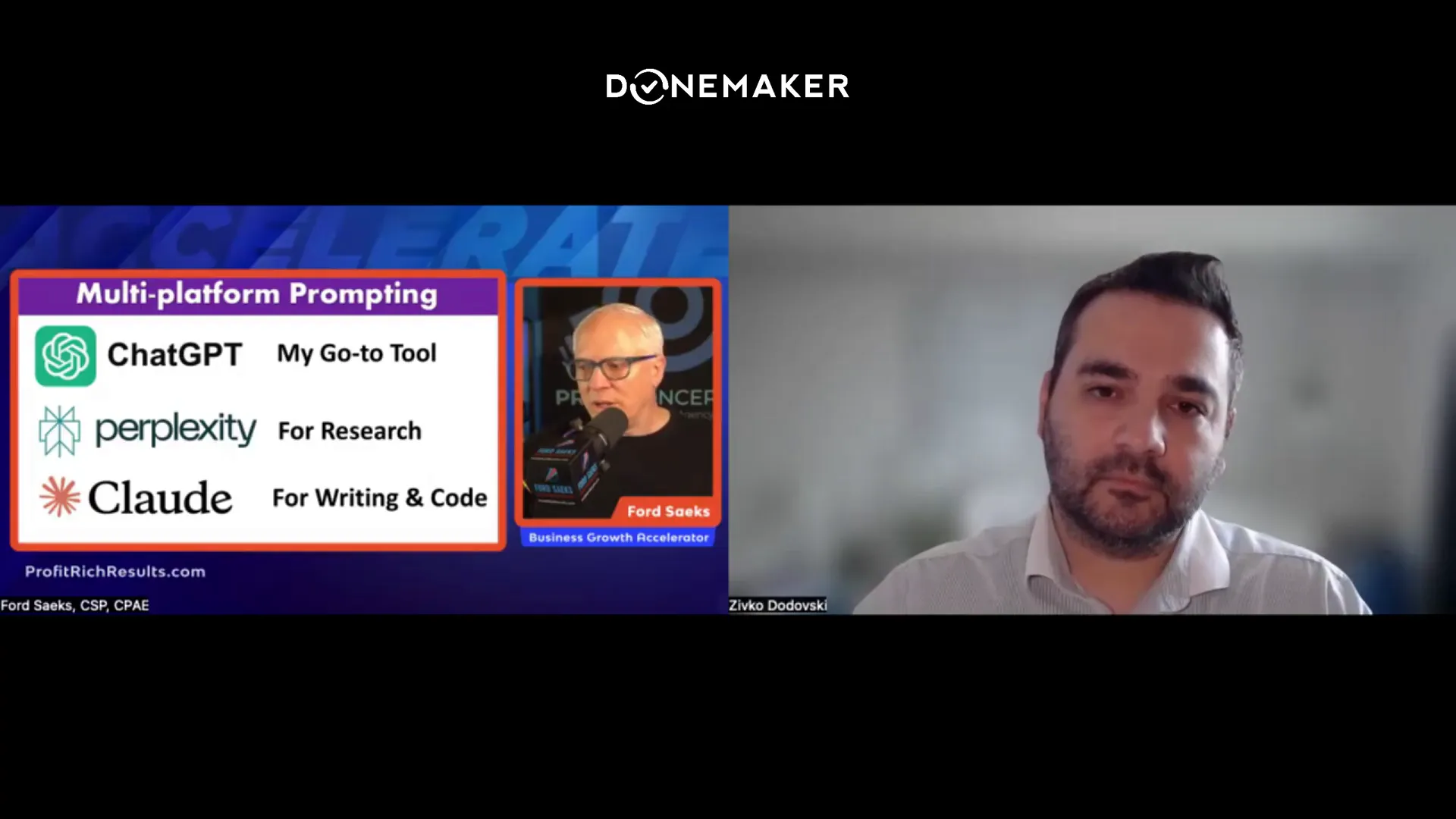
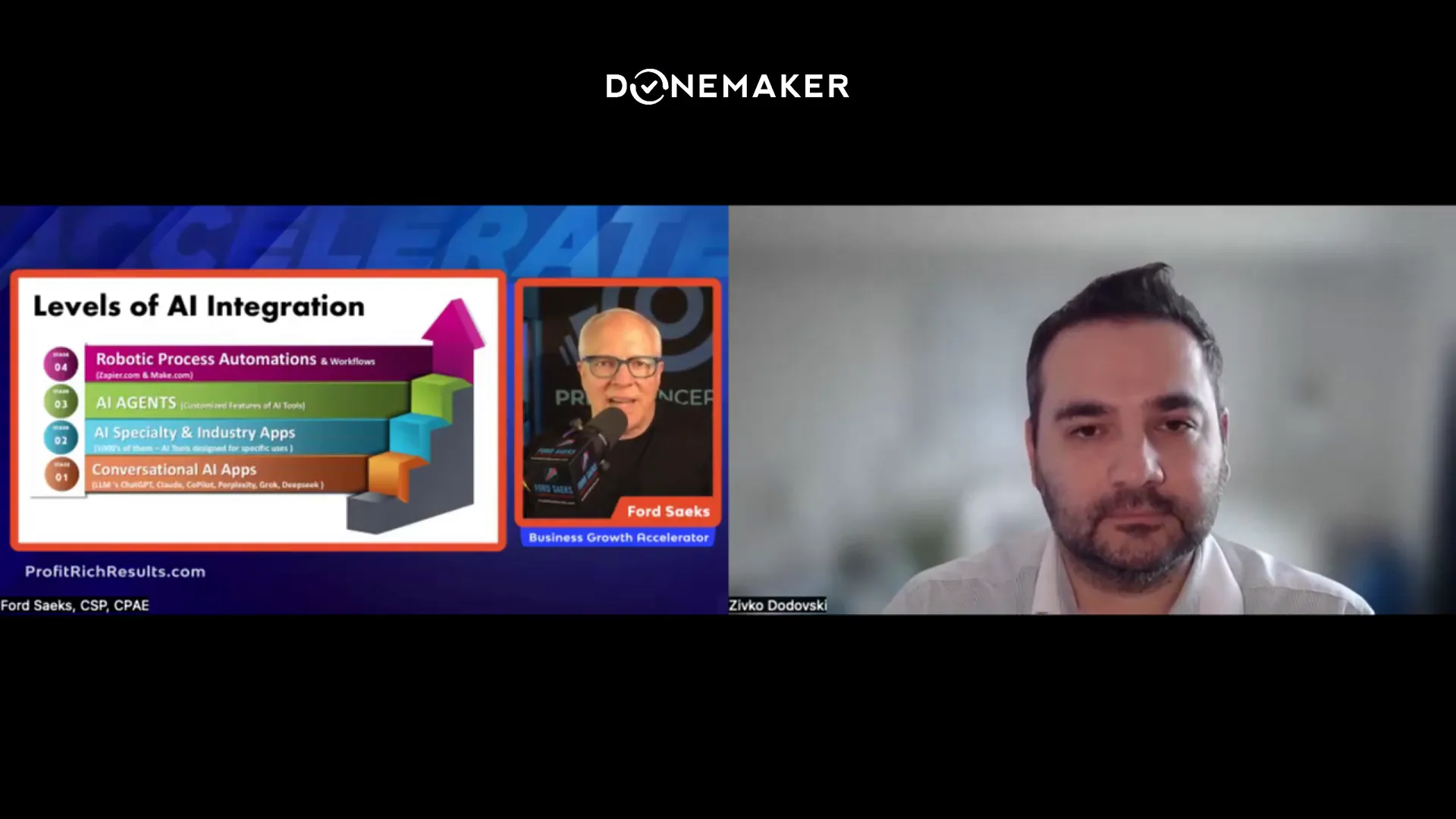
If you are worried about AI changing roles, here’s the clear path he recommends for you:
- Level one — conversational AI: get comfortable with ChatGPT, Perplexity, Claude, Copilot. Use them on your phone. Practice multi-modal interaction.
- Level two — specialty apps: use tools designed for single tasks (audio repurposing, summarization, transcription).
- Level three — AI agents: build brand-specific agents that act like mini-employees for repetitive tasks or research.
- Level four — robotic process automation (RPA): integrate triggers and workflows so AI actions trigger real-world processes.
Start simple. Ford’s repeated mantra: “Start simple, get complicated later.” Don’t expect to go from zero to a full AI-driven ops center overnight. Learn to prompt well, then layer automation and agents when you have defined playbooks and guardrails.
8. Practice prompting like a conversation — treat AI as an expert intern
One practical skill Ford emphasizes is how you prompt. Don’t just type a single command and hope. Instead, treat the tool like an expert who needs to interview you:
- Upload your master document (company overview, products, voice guidelines).
- Ask the AI to interview you — to ask clarifying questions before producing output.
- Use iterative prompts, review output, correct, and refine.
This approach reduces hallucinations and increases relevance. You’re steering the model with context rather than expecting it to guess your company’s nuance. When you get into long-term automation or agents, this discipline becomes mandatory.
9. Protect data and set privacy defaults from day one
Ford’s practical counsel on security is straightforward: go into settings for every tool you use and disable training on your data unless you use enterprise offerings that guarantee private models. Risk management matters.
Quick checklist for you:
- Click account/privacy settings for every AI tool you use.
- When possible, use enterprise models or on-prem solutions for sensitive financial and customer data.
- Create a brand training document with your IP, policies, and tech stack to control how AI is instructed about your specifics.
Ford points out that AI already “knows” a lot about public people and companies. That’s why you must monitor results and validate any output that affects public content, legal text, or financial systems.
10. Don’t be seduced — AI can hallucinate, be biased, and make mistakes
AI isn’t infallible. Ford warns you about common pitfalls: hallucinations, bias, and false precision. This is where the Success Mindset matters again: maintain human oversight and treat AI as a force multiplier, not an autopilot.
Practical guardrails:
- Always fact-check outputs that will be published or used for legal/financial decisions.
- Use AI to draft, then have a human editor or SME validate.
- Don’t automate customer-facing decisions without escalation paths to humans.
11. Use AI to raise the floor — but live experiences will become premium
Ford believes AI will raise the baseline capability of workers everywhere — like how Microsoft Office raised productivity decades ago. But that shift will also make live, human experiences more valuable. People will pay for real live interaction when the AI alternative is ubiquitous.
That means you should position your business so that routine tasks are automated while premium interactions — strategy sessions, keynote presence, careful coaching — remain human-centered and high-value.
12. Build an AI training folder and treat it as company IP
Ford recommends creating one master document that contains everything about your brand: mission, products, tech stack, customer journey, testimonials, policies, and procedures. Use that document to train agents and tools so output aligns with your voice and standards.
How to start today:
- Open a doc and write your company overview (one paragraph).
- List target audiences and sub-buckets.
- Summarize standard workflows and tech stack.
- Upload to Perplexity or your chosen tool and ask the tool to interview you to expand missing sections.
13. Use the right tools for content repurposing — leverage automation for scale
In practice, Ford uses specialty tools to scale content: he records a keynote, then uses tools like Opus Clip, Descript, and others to turn long-form content into dozens of short pieces. That’s how you get better ROI on speaking, podcasts, and webinars.
If you want to start small, pick one process (e.g., converting a 60-minute talk into 40 short clips) and automate it. Measure the impact and then scale to other assets.
14. Hiring and AI: prompt skills are becoming table stakes
As you hire, expect the workforce to require AI familiarity. Ford’s view: hire for attitude, train for skills. But do check for practical evidence of competency — what did the candidate produce with AI in the last 90 days?
Interview prompts you can use:
- Show me an AI prompt you wrote and resulting output you edited.
- Explain a time you used AI to save your team time or cost.
- Walk me through a workflow you automated with AI tools.
15. NDAs and AI: realistic expectations and legal guardrails
Ford is blunt: NDAs that prohibit AI use are likely short-lived. The genie is out of the bottle. Instead of trying to ban AI, build contract clauses that manage IP responsibility and require clients to warrant that they own rights to the content they provide.
Practical contract language topics:
- Client warrants rights to provided content.
- Define acceptable sources for creative input.
- Specify whether vendor AI outputs are permitted to be trained on customer data.
16. Action plan: what to do this week to build your Success Mindset
If you want to act on Ford’s teaching right now, here’s a compact to-do list you can complete within seven days. These steps embed both the Success Mindset and practical AI usage.
- Rate your mindset (1–10) and pick one behavior to improve (e.g., 15 minutes of focused learning daily).
- Run a single small test (email campaign or a repurposed short video) and define tracking metrics.
- Write one benefit-led headline and one supporting feature list for a top offering.
- Create your one-page brand training doc and upload it to a conversational AI tool.
- Set privacy defaults for any AI tools you use and explore enterprise options if you handle sensitive data.
Each step supports your Success Mindset: you’re deliberately measuring, learning, and iterating
Now go apply one change this week. Measure it. Learn from it. Repeat it. That’s the Success Mindset in practice.
Watch the full podcast here: This Surprising Advice Changed My Mind About Success! – Ford Saeks – DoneMaker Podcast