LinkedIn has become the go-to platform for B2B LinkedIn outreach, with professionals sending millions of messages daily. Yet, most fail to get responses because they lack LinkedIn message personalization.
Generic “I’d love to connect” notes get ignored, while tailored messages stand out and drive real engagement. If you’re serious about LinkedIn lead generation, personalization isn’t optional—it’s essential. Studies show personalized messages get 50-85% higher response rates than generic templates (Backlinko).
Whether you’re in sales, recruiting, or business development, mastering LinkedIn organic outreach separates successful campaigns from wasted efforts.
This in-depth guide will walk you through six proven personalization techniques to boost your B2B lead generation success on LinkedIn. You’ll learn:
- How to research prospects for maximum relevance
- The right way to structure high-converting messages
- Role-specific messaging frameworks for executives vs. managers
- How to leverage mutual connections and interests
- Follow-up strategies that actually work
Plus, we’ll answer the most-searched questions about LinkedIn outreach and include data-backed best practices. Let’s dive in.
Why Personalized LinkedIn Messages Outperform Generic Outreach
Before we get into the tactics, let’s examine why LinkedIn message personalization delivers better results for B2B lead generation:
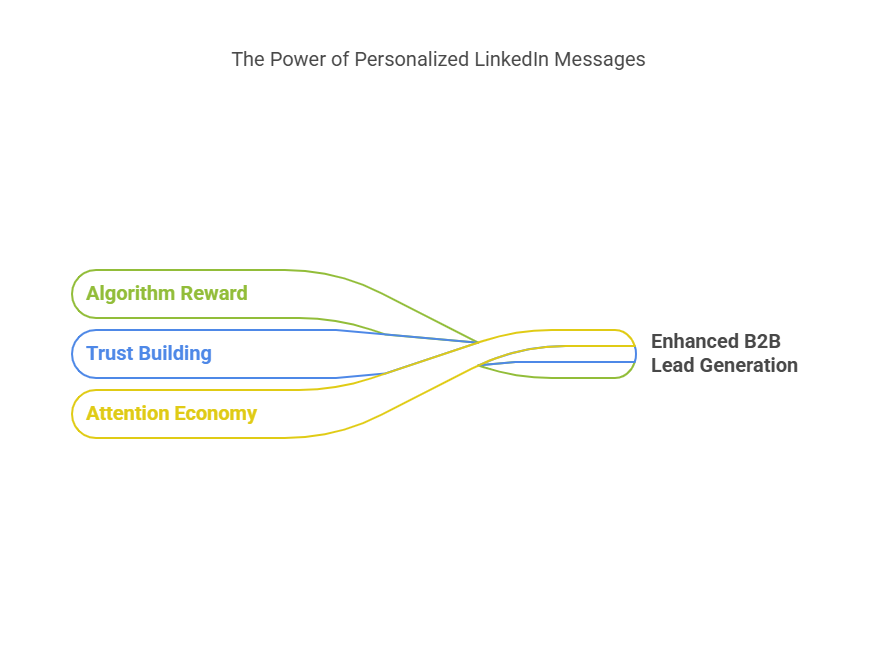
1. The Attention Economy Favors Relevance
With the average professional receiving dozens of LinkedIn messages weekly, only the most relevant get opened. A study by LinkedIn found that messages referencing a recipient’s recent activity get 30% more responses.
2. Personalization Builds Trust Faster
Generic outreach feels transactional. When you mention specific details—like a recent post, career milestone, or shared connection—you establish credibility before asking for anything.
3. LinkedIn’s Algorithm Rewards Meaningful Interactions
Engagement (replies, reactions, profile visits) signals to LinkedIn that your message is valuable. This improves deliverability for future LinkedIn organic outreach.
Key Stat:
- Personalized subject lines increase open rates by 26% (Campaign Monitor)
- Messages with 1-2 personalization elements get 2.5x more replies (Sales Insights Lab)
Now, let’s explore the five most effective ways to personalize your LinkedIn messages.
1. Deep Research: The Foundation of High-Converting Messages
What to Look for Before Messaging Someone
Effective LinkedIn message personalization starts with research. Spend 2-3 minutes reviewing:
✔ Profile Headline & About Section – What do they emphasize? (e.g., “Helping SaaS companies scale” vs. “Digital transformation leader”)
✔ Recent Activity – Have they posted, commented, or shared anything lately?
✔ Career Timeline – Any promotions, job changes, or projects worth noting?
✔ Mutual Connections/Groups – Do you share contacts or belong to the same groups?
✔ Company News – Funding rounds, product launches, or press mentions
How to Turn Research Into a Personalized Message
Example 1: Referencing a Recent Post
❌ Generic: “Hi John, let’s connect!”
✅ Personalized: “Hi John, your post on ABM strategies for enterprise sales resonated—especially the point about aligning sales/marketing KPIs. We’ve seen similar challenges with our clients at [Your Company]. Would love to hear your take on [specific question].”
Example 2: Noting a Career Milestone
❌ Generic: “Congrats on the new role!”
✅ Personalized: “Hi Sarah, congrats on the Head of Growth role at [Company]! Given your focus on scaling PLG motions, I thought you might find our case study on [relevant topic] helpful. Happy to share if you’re interested.”
Pro Tip:
Use tools like Sales Navigator to uncover personality insights for even deeper personalization.
2. The Art of Name Placement & Contextual Openers
Why First Impressions Matter
The first 10 words determine whether your message gets read or ignored. Here’s how to optimize them:
✔ Use their name naturally – Not just “Hi [Name],” but woven into the context.
✔ Lead with value – A compliment, useful resource, or intriguing question.
✔ Avoid overused phrases – “I came across your profile” is a red flag for spam.
High-Converting Opening Lines
Networking
Weak Opener: “Let’s connect!”
Strong Opener: “Hi [Name], I noticed we both work with [Industry] companies—would love to exchange insights.”
Sales Outreach
Weak Opener: “Interested in our solution?”
Strong Opener: “[Name], your team’s recent work on [Project] caught my eye. We helped [Similar Company] achieve [Result]—could that be relevant for you?”
Job Seekers
Weak Opener: “Looking for opportunities?”
Strong Opener: “Hi [Name], your experience at [Company] aligns perfectly with what we’re building at [Your Company]. Would you be open to a quick chat?”
Psychology Trick:
People are more likely to engage when you mention their name mid-sentence rather than at the start. Example:
“That was a great point you made, [Name], about [topic]…”
3. Leveraging Shared Connections & Interests
Why Social Proof Works
A Stanford study found that referrals convert 5x better than cold outreach. On LinkedIn, you can tap into:
✔ Mutual Connections – “Small world—we’re both connected to [Shared Contact]!”
✔ Shared Groups – “Noticed we’re in the [Group Name] group—some great discussions there!”
✔ Alma Mater – “Fellow [University] alum here—go [Mascot]!”
Example Messages
For Mutual Connections:
“Hi [Name], I see you know [Mutual Contact]—we worked together on [Project]. He mentioned your expertise in [Skill], which aligns perfectly with what we’re doing at [Your Company]. Would you be open to a 15-minute chat next week?”
For Shared Groups:
“Hi [Name], noticed we’re both in the ‘B2B Growth Hacks’ group. Your comment on [Topic] stood out to me. We’ve been experimenting with something similar—would love to compare notes!”
Data Point:
Messages referencing mutual connections have a 40% higher response rate (LinkedIn Data).

4. Role-Specific Messaging Frameworks
Tailoring Your Approach by Seniority
Tailoring Your Approach by Seniority
A VP cares about different metrics than a manager. Adjust accordingly:
Executives (C-level, VP)
What They Care About: Revenue impact, strategic partnerships
Message Focus: High-level outcomes, ROI, industry trends
Managers/Directors
What They Care About: Team efficiency, process improvements
Message Focus: Tactical tips, case studies, time-saving solutions
Individual Contributors
What They Care About: Skill development, tools
Message Focus: How-to guides, templates, peer insights
Message Examples
For a CEO:
“Hi [Name], [Company]’s recent expansion into [Market] is impressive. Many CEOs in your space are telling us they’re focused on [Challenge]. We helped [Similar Company] reduce [Problem] by 30%—would that be relevant to explore?”
For a Marketing Manager:
“Hi [Name], loved your recent campaign around [Initiative]. We’ve found that teams using [Tactic] see 2x more engagement. Happy to share the playbook if useful!”
5. The Give-First Approach: Providing Value Before Asking
Why It Works
Asking for a call or meeting upfront feels transactional. Instead:
✔ Share a relevant resource (article, tool, or template)
✔ Offer genuine praise (specific to their work)
✔ Ask an insightful question
Examples:
Sharing a Resource:
“Hi [Name], your post on [Topic] was spot-on. We just published a guide on [Related Topic] ([Link])—thought you might find it useful. Would love to hear your thoughts!”
Asking a Thoughtful Question:
“Hi [Name], I noticed [Company] recently launched [Product]. How are you thinking about [Specific Challenge]? We’ve seen some interesting approaches in [Industry].”
Data Point:
Messages offering value first get 60% more replies than direct asks (HubSpot).
6. Our Human-First Approach to LinkedIn Outreach at DoneMaker
At DoneMaker, we know LinkedIn outreach isn’t about blasting messages – it’s about starting real conversations. Our entire methodology is built on three core beliefs that drive our LinkedIn organic outreach services:
What Makes Our LinkedIn Outreach Different
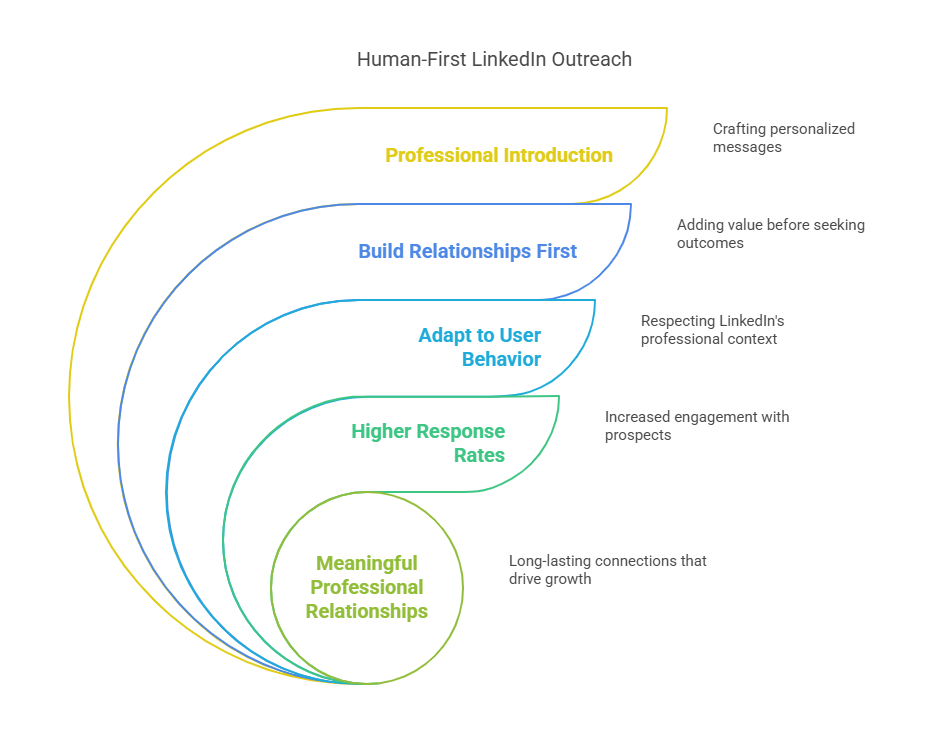
- We Treat Every Message as a Professional Introduction
- No templates, no bots – every message is handcrafted
- We research each profile to find natural connection points
- We write like real professionals, not salespeople
- We Focus on Building Relationships First
- Our first messages never pitch – they start conversations
- We look for ways to add value before asking for anything
- We nurture connections over time, not just for immediate results
- We Adapt to How People Actually Use LinkedIn
- We message when it makes sense in someone’s workflow
- We respect LinkedIn as a professional network, not a sales channel
- We follow up thoughtfully, not aggressively
Why This Approach Gets Better Results
After running thousands of outreach campaigns, we’ve found this human-first approach delivers:
- 3-5x higher response rates than template-based outreach
- More meaningful conversations that actually lead to opportunities
- Longer-lasting professional relationships beyond any single campaign
The key insight that drives our work? People respond best when they feel respected as professionals, not targeted as leads. That’s why we:
✔ Take time to understand each prospect’s world
✔ Find natural ways to connect (shared interests, mutual connections)
✔ Always lead with value before asking for time or consideration
This is how we help our clients stand out in crowded inboxes and build the kind of professional relationships that drive real business growth. Because at the end of the day, LinkedIn works best when we remember we’re connecting with people, not just profiles.
Final Recommendations
Now that you understand the power of personalized LinkedIn outreach, here’s how to implement these strategies effectively:
1. Create a Personalization Checklist
Before sending any message, ensure you’ve:
✔ Reviewed the recipient’s profile thoroughly
✔ Identified at least 2-3 personalization points
✔ Crafted a message that references these specifics naturally
✔ Included a clear but gentle call-to-action
2. Build a Research Routine
Dedicate time for proper prospect research:
- Spend 3-5 minutes per profile initially
- Use tools like Sales Navigator to save research time
- Create a simple template to capture key personalization points
3. Develop a Message Framework
While each message should be unique, having a structure helps:
- Personalized opener (reference something specific)
- Value statement (what you can offer)
- Natural transition to conversation
- Clear but low-pressure CTA
4. Track and Optimize Your Approach
Measure what works:
- Keep a simple spreadsheet tracking:
- Message type (post reference, mutual connection, etc.)
- Response rates
- Conversion rates
- Adjust your approach based on what generates the best results
5. Balance Automation with Authenticity
If scaling your outreach:
✔ Use tools to help with research and tracking
✔ But always maintain human-written messages
✔ Never fully automate the personalization process
6. Commit to Continuous Improvement
- Set aside 30 minutes weekly to review what’s working
- Test different personalization angles
- Stay updated on LinkedIn’s changing algorithms and features
7. Consider Professional Support When Scaling
If you’re ready to scale your outreach but want to maintain quality:
- Our team at DoneMaker specializes in human-powered, personalized LinkedIn outreach
- We combine these best practices with proven systems for consistent results
- Learn more about our LinkedIn Outreach Services
Remember: The most successful LinkedIn outreach combines strategic personalization with authentic human connection. Start small, focus on quality over quantity, and gradually scale what works for your specific audience and goals.
Frequently Asked Questions (FAQ’s)