AI is not valuable because it can produce more words, more ads, or more automated tasks. It is valuable when it helps a business produce better work with more consistency, while freeing people to focus on the moments where being human creates the biggest advantage.
That distinction changes everything.
A growing marketing operation can use AI to launch campaigns, review reports, identify mistakes, find relevant opportunities, analyze customer patterns, and work through recurring systems. But there is a hard line: the technology should not become a shortcut for manufacturing trust, pretending that a customer had an experience they never had, or replacing meaningful sales conversations with robotic communication.
The strongest AI strategy is not “automate everything.” It is: automate the repeatable work so your team can do more of the work that requires judgment, creativity, and trust.
Table of Contents
- Stop Measuring AI Only by Cost Savings
- How AI Can Replace Repetitive Roles Without Replacing Standards
- Where AI Should Never Be the Front Line
- The Trust Line: Never Fake Testimonials or UGC
- Why Personally Written Messages Still Win
- Use AI to Analyze Creative, Not to Replace Original Thinking
- When Building In House Beats Paying Another Subscription
- Local SEO Has Not Fundamentally Changed
- The Three Headed Local Growth Strategy
- Better Meta Ads Start With Better Optimization Choices
- Why Radius Targeting Can Appear Strange
- Why Google and Meta Still Lead the Paid Media Conversation
- Find the Recurring Task That Changes Your Business
- A Better Kind of AI Newsletter
- The Big Lesson: Automate the Work, Not the Relationship
Stop Measuring AI Only by Cost Savings
The most common business case for AI is efficiency. Tasks that once took hours may now take minutes. That is real, and it matters. But efficiency alone is an incomplete metric.
Running a serious AI workflow is not necessarily cheap. High usage requires tokens, connected tools, recurring tasks, and carefully designed systems. The cost does not simply vanish. It shifts.
The better question is not, “How cheaply can this be done?” Ask: “Does this improve the quality and reliability of the output?”
For a marketing agency, that means AI can take on the tedious mechanics behind campaign launches. Instead of manually uploading creative variations, headlines, ad copy, descriptions, tracking details, and pixel configurations one piece at a time, connected AI systems can handle much of the campaign setup.
That reclaimed time should not automatically be filled with more automation. It can be redirected to higher value activities:
- Responding personally to emails.
- Calling a client or prospect in real time.
- Attending local events and industry conferences.
- Building relationships with partners.
- Reviewing strategy and creative direction.
- Making judgment calls that cannot be reduced to a workflow.
This is the real opportunity. AI does the operational heavy lifting while the business becomes more available, responsive, visible, and human.
How AI Can Replace Repetitive Roles Without Replacing Standards
In many businesses, repetitive work was historically handed to virtual assistants, contractors, or offshore teams. Website updates, data entry, basic coding, campaign adjustments, and content uploads all had to move through a chain of people.
The problem was not that people were incapable. The problem was consistency. Every handoff created potential for misunderstanding, missed details, errors, retraining, and delays. Then another role was often required to check the work.
AI can change that workflow when the business has created clear processes. It can review content for mistakes, compare work against requirements, flag inconsistencies, and provide a far more repeatable quality assurance layer than an improvised manual system.
That does not mean an organization should trust every output blindly. It means the business can build its standards into the work itself rather than hoping every new person learns those standards perfectly.
The advantage of persistent guardrails
A trained employee can leave. A contractor can be unavailable. A new assistant needs onboarding. Even a great hire may interpret a process differently from the person who designed it.
AI workflows can preserve the operational knowledge of the company. The guardrails stay in place. The instructions do not drift simply because a team member changes.
For campaign management, one useful structure is a dedicated skill for launching Meta campaigns. That skill can contain:
- The client’s ideal customer profile, or ICP.
- Their main pain points.
- The offer and target service area.
- The business positioning.
- The approved messaging and ad angles.
- The campaign structure and launch process.
- The quality checks required before publication.
When these elements are built into the workflow, the system starts from the company’s actual strategy rather than a generic prompt. That reduces the need to retrain each new employee on every operational detail.
The lesson is crucial: AI quality is directly related to the quality of the rules, context, and standards you give it. A vague request creates vague work. A well designed business system creates more dependable output.
Where AI Should Never Be the Front Line
Automation can improve sales intelligence without taking over sales conversations.
AI can analyze CRM records, surface patterns in prospect behavior, identify which content attracts better clients, and help a team prioritize. Those are powerful uses. They turn scattered information into usable insight.
But frontline sales communication is different.
When a business owner is making a high trust decision, especially around digital marketing or other important services, they often want to know that there is a real person on the other side. In fact, people have become skeptical enough that sales representatives are sometimes asked to prove that they are human.
That skepticism is not irrational. AI voices and automated messaging have become familiar, and many prospects are tired of impersonal outreach. A human conversation signals attention, accountability, and effort.
The right division of labor is clear:
- Use AI for analysis: qualification, CRM insights, reporting, lead patterns, and content performance.
- Use people for connection: calls, relationship building, discovery, problem solving, and personal follow up.
AI should make the salesperson better prepared, not make the prospect wonder whether the business cares enough to show up personally.
The Trust Line: Never Fake Testimonials or UGC
AI can generate polished visuals, video concepts, commercials, and creative variations with astonishing speed. That makes it tempting to use synthetic people, AI testimonials, or simulated user generated content.
This is where brands need discipline.
A testimonial is not simply a marketing asset. It is social proof. It implies that a real customer used a product or service and experienced a real outcome. Creating that experience artificially creates a serious trust problem.
If a customer suspects that a testimonial was invented, a much bigger question immediately follows: What else is this company willing to fake?
The same applies to UGC. User generated content works because it feels like evidence from an actual person with actual experience. When a brand uses AI to fabricate that experience, it undermines the very reason the format works.
AI can still play a productive role in creative work. It can help develop commercial concepts, brainstorm visual approaches, create production ideas, generate hooks, and test multiple messaging directions. It can make a campaign more imaginative.
But it should not be used to falsely represent a customer experience.
A practical authenticity test
Before publishing AI assisted content, ask one straightforward question: Would a reasonable customer believe this person, story, product use, or result is real?
If the answer is yes, make sure it is real. If it is not real, it should not be positioned as customer proof.
As AI becomes more common, trust will become one of the few assets that cannot be cheaply generated. That is why conferences, client calls, interviews, and direct conversations matter so much. They create credibility through real interaction.
Why Personally Written Messages Still Win
AI can draft emails, LinkedIn messages, nurture sequences, and follow ups. Yet a message can be technically polished and still feel empty.
That happens when a draft lacks the sender’s personal stories, emotional rhythm, specific opinions, and lived context. A generic AI version may sound close, but “close” is not always enough when the goal is to build a relationship.
Personally written outreach often stands out precisely because it reflects effort. It sounds like someone took the time to think about the recipient rather than pasting a generated sequence into an automation tool.
In an environment full of repetitive AI messaging, effort itself becomes a differentiator.
That does not mean every message must be written manually to thousands of contacts. That is not a realistic system. The smarter approach is to use AI to reduce a large prospect list to the smaller group that deserves a personal message.
For example, AI can analyze 1,000 prospects and help identify the 100 best fits based on relevance, needs, signals, and likely value. Then a human can write the messages that matter.
This is a much better use of automation:
- Use AI to research, sort, and prioritize.
- Use human judgment to select the strongest opportunities.
- Write the important outreach personally.
- Use the response data to improve future targeting.
The result is not just greater efficiency. It is better allocation of attention.
Use AI to Analyze Creative, Not to Replace Original Thinking
AI is excellent at generating options. It can produce hooks, headlines, angles, copy variations, and creative directions in seconds. Those capabilities are useful, especially when a team needs volume for testing.
But the best ad idea may not come from a prompt.
It might emerge during a conversation, from a difficult customer question, from a moment of frustration, or from an unexpected thought in the shower. Those ideas often work because they are specific, surprising, and rooted in a real understanding of the customer.
Generic model output is built from patterns that already exist. Human insight is where genuinely differentiated angles begin.
The ideal creative process looks like this:
- Start with a real human observation.
- Develop the core idea and message with judgment.
- Use AI to generate executions and variations.
- Launch tests efficiently.
- Use AI to analyze results, patterns, and next actions.
That last part is especially powerful. AI can study campaign data at scale, identify which messages are connecting, spot performance trends, and help determine where budget or creative attention should go next.
In other words, AI can become a strategic analyst. It does not have to become the creative director.
When Building In House Beats Paying Another Subscription
Third party AI tools can be helpful, but they also create dependency. A business may build workflows around a connector, only to face sudden price changes or account limits.
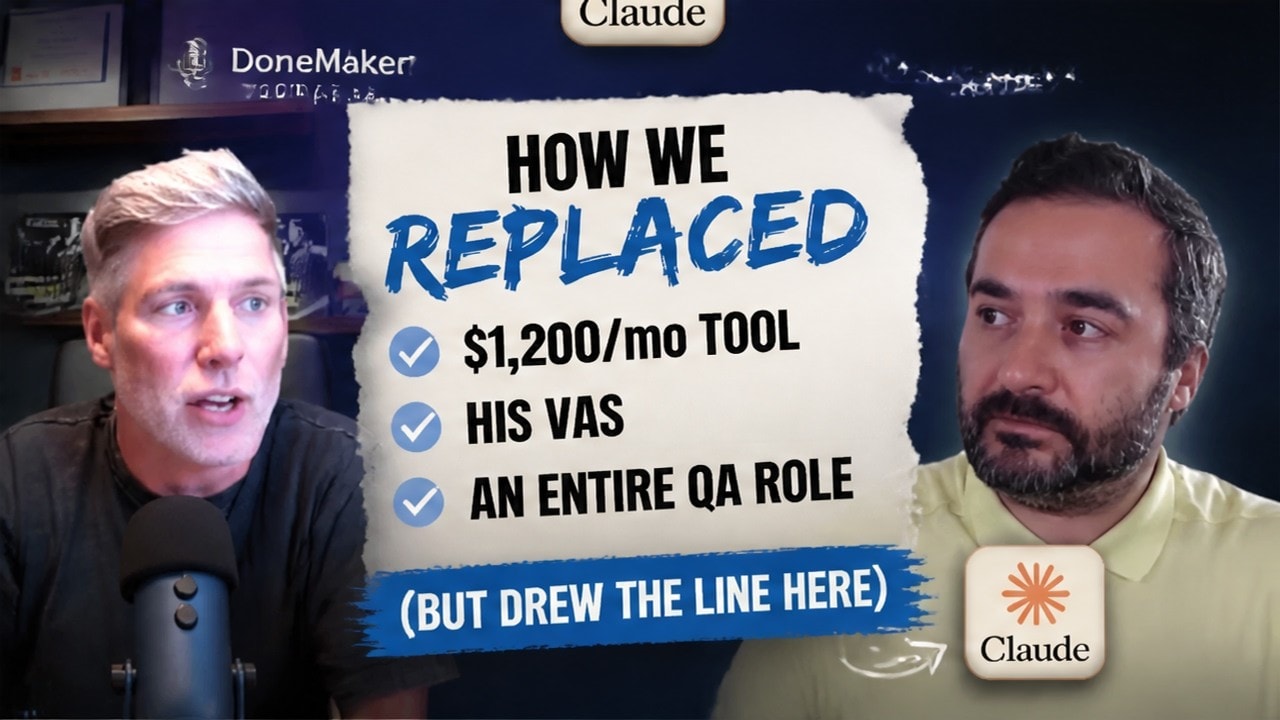
One marketing platform used to connect AI with Google Ads and Meta Ads changed its pricing dramatically. A plan that had cost roughly $150 per month became about $1,200 per month after limits on accounts changed. For an operation managing many accounts, that kind of jump is impossible to ignore.
The response was to build an internal alternative. A custom MCP connection was developed to manage dozens of Google Ads accounts without relying on the expensive third party tool.
This does not mean every business should build its own technology. Custom development requires technical capacity and comes with maintenance responsibility. But it does highlight an important strategic question:
Are you paying for a critical capability that your team could own?
That question becomes more relevant as AI lowers the barrier to creating internal tools. Small applications can now be built for narrow, high value workflows that once required expensive software subscriptions.
Beware the feature that becomes free
There is another side to this trend. Many standalone AI products will struggle because major platforms keep absorbing common features.
A business may spend heavily building a chatbot, only to find that website platforms and larger software providers quickly offer similar chatbots for free or include them in existing plans. The same pattern is appearing across automation, design, content, CRM, and integration tools.
The strategic takeaway is not “never build.” It is “build carefully.”
- Do not create a product around a feature that a large platform can easily bundle.
- Prioritize internal tools that solve a unique workflow problem.
- Assess whether a subscription has a durable advantage or only temporary novelty.
- Keep ownership of the systems that are most central to your delivery model.
Local SEO Has Not Fundamentally Changed
Terms such as AEO, GEO, and AI search optimization can make it seem as though traditional local SEO has been replaced. In practice, the foundation is still familiar.
Search engines and AI platforms both aim to surface credible, authoritative answers. For a local service business, that means demonstrating expertise in the services offered and in the geographic areas served.
When someone needs a nearby accountant, landscaper, contractor, or restaurant, Google search and the local map pack remain highly important. Search behavior for local services has not completely shifted to AI chat tools.
AI platforms may be useful for researching a recipe or exploring a broad question. But a local buying decision often requires maps, proximity, business information, ratings, and direct comparisons. That is still a core Google use case.
The local SEO playbook remains focused on authority:
- Create a website that clearly communicates expertise.
- Optimize for relevant service and location intent.
- Build credibility across local search signals.
- Position the business as the more informed, relevant choice.
- Make it easy for high intent prospects to take action.
The labels may evolve. The goal does not: be the trusted expert that platforms can confidently recommend.
PR and published thought leadership can strengthen authority
Public relations can support SEO and AI visibility when it produces credible thought leadership, especially published papers or materials placed through reputable sources.
A well developed published paper carries more weight than a random blog post because it can signal a more authoritative source of expertise. It becomes another asset supporting the brand’s reputation in search systems and AI models.
PR is most useful when it complements the broader authority strategy. It is not a magic trick. A single announcement will not replace strong local SEO, useful content, clear positioning, and a credible website.
The Three Headed Local Growth Strategy
For many local businesses, the strongest digital marketing mix is a combination of local SEO, Google Ads, and Meta retargeting.
Think of it as a three headed growth engine:
- Local SEO captures high intent searches and builds long term authority.
- Google Ads creates immediate visibility for targeted search demand.
- Meta retargeting keeps the business top of mind after someone visits the website.
Consider an accounting firm. A potential client may search for an accountant nearby, see a paid Google result, find a business in the map pack, and visit several websites before making a decision.
Many people naturally click an organic listing before a sponsored result. That makes local SEO essential. But paid search still provides valuable visibility, especially for high intent keywords. Then Meta retargeting can reappear later on Facebook or Instagram, helping the business remain memorable while the prospect compares options.
Testimonial ads can be especially effective in retargeting because they provide legitimate proof from real past clients. Lead magnets and helpful free resources can also help build intent among people who are not yet ready to engage.
The key is coordination. Each channel supports the others.
Better Meta Ads Start With Better Optimization Choices
Meta’s algorithm is extremely sophisticated, but it will pursue exactly the objective you give it. That is why campaign setup matters.
A practical benchmark is to aim for roughly 50 conversions, engagements, or other optimization events per week. This gives the platform enough activity to learn who is most likely to take the desired action.
If a campaign cannot reach 50 leads per week because the offer is high ticket, the business may need to optimize for a higher volume event such as landing page views. The goal is to give the algorithm enough signals without losing sight of business outcomes.
The critical issue is choosing the right event.
If you optimize for video views, Meta will seek people who tend to watch videos. Those users may be excellent at consuming content and terrible at buying. A campaign optimized for video views can generate impressive engagement while producing very few conversions.
The platform is not failing. It is following instructions.
Meta is not listening to your phone
It can feel eerie when ads seem connected to a recent thought or conversation. But the more practical explanation is that Meta has extensive behavioral signals from activity on its platforms.
Stopping briefly on an ad for yellow shoes, clicking through a carousel, completing a video, commenting, sharing, or visiting a profile all provide signals. The platform learns what formats, colors, topics, and behaviors attract your attention.
Someone who repeatedly engages with carousels may receive more carousel ads. Someone who consumes short videos may receive more short video ads. Someone who clicks on a shoe ad may suddenly see multiple shoe brands competing for attention.
That is why ads cannot be bland. The algorithm can place an ad in front of relevant people, but many competitors may be trying to reach the same group. The creative still has to win the moment.
Why Radius Targeting Can Appear Strange
A business may target a specific local radius and later see engagement associated with people who live far away. That does not automatically mean click bots, click farms, or wasted spend.
A person from another city may have been in the target area while commuting, working, visiting, or passing through on a highway. If they were physically in the selected location when the ad was served, the campaign may still have followed the targeting settings correctly.
Location configuration errors are possible, so campaigns should always be reviewed carefully. But a distant home location does not necessarily prove that the ad reached someone outside the intended area.
Keep the focus on the bigger signals: quality leads, relevant engagement, conversion performance, and the accuracy of the campaign setup.
Why Google and Meta Still Lead the Paid Media Conversation
New ad options may emerge within AI platforms, but Google Ads and Meta Ads remain the core paid media channels for many businesses. Google captures existing intent. Meta creates demand, supports retargeting, and offers deep behavior based delivery.
LinkedIn can work in specific business to business situations, but its lead costs are often significantly higher than Meta’s. Creative that performs well on Meta does not automatically perform as well on LinkedIn, where the active audience pool and engagement signals are different.
LinkedIn offers professional targeting through job titles and related criteria. Yet the combination of higher costs and weaker lead quality can limit its value for some campaigns. Platform selection should be based on the business model, audience, and budget, not prestige.
For now, the strongest approach is to master the channels most likely to produce results before spreading attention across every new ad platform.
Find the Recurring Task That Changes Your Business
The most exciting AI opportunities often come from asking a different question: What recurring work is quietly draining time every month?
One powerful example is conference outreach. Finding relevant events, identifying speaking opportunities, completing applications, and tracking submissions can consume an enormous amount of effort. It is exactly the kind of ongoing research and administrative process that AI can support.
A scheduled monthly task can search for events related to a specific area of expertise, identify strong matches, complete relevant application steps, and provide an update on what was found or submitted. That process has helped create real speaking opportunities that may otherwise have been missed.
Another example is social media repurposing. Producing ten different versions of a post for ten platforms used to require hours of manual rewriting. A small custom application can generate platform specific drafts based on desired tone and format, then leave the final tweaks to a human. A workflow that once took roughly three hours can fall to around 40 minutes while preserving distinct messaging for each platform.
The pattern is simple:
- Identify a repetitive task.
- Document how good work is done.
- Build the process into an AI skill or internal tool.
- Keep human review where tone, trust, and judgment matter.
- Run it repeatedly and improve it over time.
A Better Kind of AI Newsletter
AI can also help turn everyday conversations into useful knowledge. A weekly workflow can review recorded business conversations, identify the strongest lesson, and organize it into a concise format.
One effective framework is Think, Try, Listen:
- Think: one short idea worth considering.
- Try: one practical action based on that idea.
- Listen: one relevant podcast episode connected to the theme.
The result is a short email that can be read in about two minutes. It avoids the bloated newsletter format while still delivering a real insight.
AI makes the review and synthesis possible. Human judgment makes the final lesson useful.
The Big Lesson: Automate the Work, Not the Relationship
The strongest businesses will not be those that automate the most. They will be the ones that automate with purpose.
Use AI to launch campaigns faster. Use it to check quality, analyze data, prioritize leads, build internal tools, find opportunities, and reduce repetitive work. Build guardrails so your standards are applied consistently.
Then use the time you get back to write the message only you can write. Make the call only you can make. Attend the meeting. Develop the unusual creative idea. Build real proof. Earn real trust.
That is the edge.
For additional resources on building a sales pipeline, explore the free sales pipeline resources. For one to one support focused on getting clients through LinkedIn, book a LinkedIn client acquisition call.
Frequently Asked Questions
Can AI replace virtual assistants and quality assurance roles?
AI can take over many repetitive tasks previously handled by virtual assistants and can improve quality checks when business processes, standards, and guardrails are clearly documented. Human oversight is still important for strategic decisions and sensitive work.
Should businesses use AI for sales calls and customer communication?
AI is useful for sales analysis, CRM insights, lead qualification, and prioritization. Direct frontline conversations are often better handled by people because trust, accountability, and personal attention matter deeply in sales.
Is it acceptable to create AI generated testimonials or UGC?
AI should not be used to fabricate customer testimonials, user experiences, or results. Testimonials and user generated content rely on authenticity. Misrepresenting synthetic content as real customer proof can damage brand trust.
Has AI search made local SEO irrelevant?
No. Local SEO remains essential because people still use Google and the map pack to find nearby services. The core strategy remains building authority, demonstrating expertise, and optimizing around relevant service and location searches.
What is the best marketing mix for a local service business?
A strong combination is local SEO for long term authority, Google Ads for immediate high intent visibility, and Meta retargeting to stay top of mind after potential customers visit the website.
Why do Meta campaigns need around 50 events per week?
About 50 weekly optimization events, such as leads, conversions, engagements, or video views, can provide enough data for Meta’s algorithm to learn which people are most likely to take the selected action.