Billboards have dominated physical advertising for decades, but they come with a major limitation: they stay put. They require fixed infrastructure, expensive placements, and measurement that often relies on estimates instead of direct evidence.
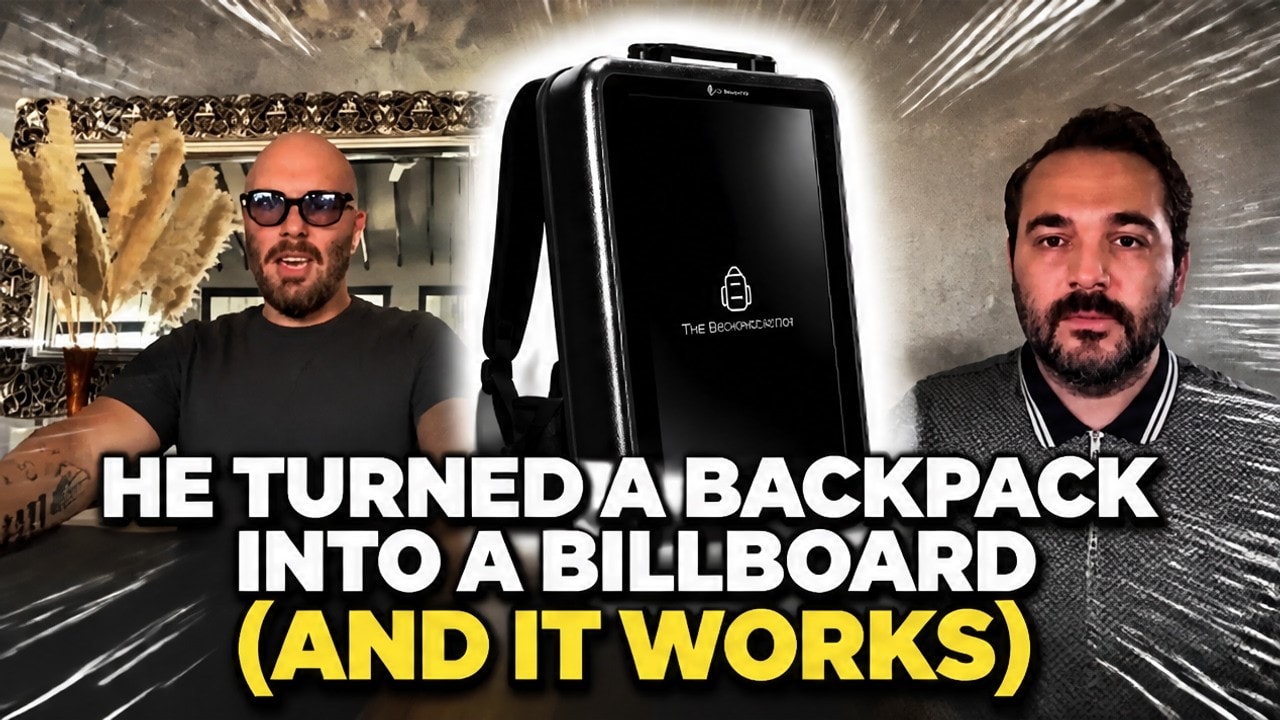
The Backpackster takes a radically different path. It turns a wearable backpack with a digital screen into dynamic, deployable out of home advertising that can move through stadiums, trade shows, college campuses, convention centers, entrances, exits, and crowded city experiences.
The bigger idea is not simply a backpack with a screen. It is a physical media network designed to connect real world attention with digital action, measurable campaign performance, and new revenue for venues and agencies.
Table of Contents
- A Moving Billboard for the Places Where Attention Already Exists
- The Core Business Case: A New Revenue Stream With Less Friction
- Why a $4,000 Backpack Campaign Can Challenge a $25,000 Booth
- From Physical Exposure to Digital Action
- 17,000 Verified Views in Two Hours
- Why Edge AI Could Make Mobile Media Smarter
- The Bigger Advertising Shift: Less Assumption, More Reliability
- Generation Z, Choice, and the Return of Real World Experiences
- Humans, Robots, and a Hybrid Future
- The Founder Lesson: The Product Is Not the Whole Business
- “Wisdom Is Crystallized Pain”: Staying Clear Through Rejection
- Vision Needs a Team, Not a Hero Story
- Culture Is the Energy People Feel Around the Work
- A New Category of Out of Home Advertising
A Moving Billboard for the Places Where Attention Already Exists
The premise is simple and powerful: place a digital display on a backpack, have trained people carry it through high traffic environments, and make advertising mobile instead of static.
That mobility changes the advertising equation. A static billboard is limited to one location. A wearable digital billboard can move with the event, follow the crowd, appear at the entrance during peak arrival, shift toward activation areas, and return to exits when people are leaving.
The Backpackster positions this as dynamic, deployable digital media for events, activations, and campaigns. It is intended for environments where attention is concentrated but traditional media options are expensive, operationally difficult, or visually repetitive.
Possible environments include:
- Stadiums and sports venues
- Convention centers and trade shows
- Music festivals and major events
- College campuses
- Experiential marketing activations
- Retail and entertainment districts
- Large public gatherings and high foot traffic zones
For advertisers, the appeal is clear. A brand can gain a visible presence inside an event without purchasing an enormous booth, building a physical display, or competing only for distant wall space.
For event operators, the appeal is just as direct. The media product can be added to an existing sponsorship and advertising inventory without building permanent signage infrastructure.
The Core Business Case: A New Revenue Stream With Less Friction
The Backpackster is built around a practical question: if a venue, agency, or event organizer already has clients, traffic, staff, and an active calendar, why not give that organization another advertising product to sell?
Traditional advertising infrastructure can demand significant investment. Installing large digital signs, building display structures, finding power sources, gaining approvals, and staffing operations can turn a straightforward campaign into a long logistical project.
The wearable model aims to reduce that burden.
The company handles the underlying technology, deployment, charging setup, and measurement. The partner organization focuses on selling the ad opportunity into its existing network of advertisers and sponsors.
That produces a value proposition based on three promises:
- No permanent infrastructure: No need to install a new billboard or screen system throughout a venue.
- No major capital investment: The partner does not need to build a new advertising platform from scratch.
- No added operational complexity: The product is intended to fit inside existing event and staffing workflows.
The model can also create earning opportunities for people already working in an event environment. Instead of treating the backpack as a replacement for human labor, the concept uses human movement as part of the media delivery system.
This is important. The wearer is not incidental to the campaign. Their ability to move through the physical flow of an event is what makes the media inventory dynamic.
Why a $4,000 Backpack Campaign Can Challenge a $25,000 Booth
Trade shows can be brutally expensive. A major booth may require tens of thousands of dollars before a brand even factors in staffing, travel, creative production, logistics, and follow up.
That pricing structure excludes many companies that want access to the event audience but cannot justify a massive exhibition spend.
The Backpackster offers another route. A company that cannot afford a $15,000, $20,000, or $25,000 booth may be able to purchase a smaller mobile advertising placement. The campaign can still place the brand inside the event, near attendees, and across key audience traffic zones.
More importantly, the brand can control a visible narrative in places where conventional options may be limited. A digital backpack can move through aisles, appear near entrances, reach exit traffic, and deliver a call to action through on screen messaging or a QR code.
That does not make booths irrelevant. A booth supports meetings, demonstrations, hospitality, and long conversations. But a mobile display can give a smaller advertiser a meaningful alternative when the goal is awareness, attention, and direct digital engagement.
From Physical Exposure to Digital Action
The strongest part of this model is the ambition to close the gap between physical advertising and digital advertising.
Historically, out of home advertising has largely been measured through assumptions. A billboard is located beside a busy road. A sign appears in a shopping center. A media operator estimates exposure from traffic patterns, audience data, and placement visibility.
Those estimates can be useful, but they do not offer the same feedback loop as digital campaigns. Digital advertising has conditioned marketers to expect dashboards, conversion paths, optimization, retargeting, and attribution.
The Backpackster aims to bring more accountability to physical media by collecting attention metrics around a campaign. The goal is to understand not just that an ad was deployed, but where it appeared, who encountered it, how people reacted, and what happened next.
The proposed premium layer adds retargeting and attribution. In practical terms, that means connecting exposure in a physical setting to follow up digital marketing activity. Rather than treating the real world and the internet as separate channels, the model seeks to create a bridge between them.
This is the key strategic shift:
- Physical media creates presence in a real environment.
- Measurement captures attention and campaign activity.
- Digital pathways create opportunities for follow up.
- Retargeting and attribution extend the campaign beyond the event.
A QR code illustrates the idea perfectly. A person encounters a branded digital backpack at a convention or high traffic activation. The screen presents a reason to scan, perhaps an offer, prize, giveaway, social profile, or event specific promotion. The physical ad becomes an immediate digital entry point.
For a brand trying to build an Instagram account or test a new campaign, that could provide a more direct path to engagement than simply paying a social platform to gradually learn who responds to an ad.
17,000 Verified Views in Two Hours
A World Cup related activation in Inglewood, Los Angeles demonstrated the potential of mobile out of home media in a concentrated crowd environment.
Using an entrance and exit deployment strategy around the Spain and Austria match, one Backpackster unit recorded more than 17,000 verified views in two hours. The reported result came through a single camera, while another camera in the setup was not accurate.
That detail matters because it shows the difference between vague exposure estimates and an effort to verify actual campaign attention.
The lesson is not that every event will generate the same volume. Crowd size, duration, placement, event flow, creative quality, and deployment strategy all affect outcomes. The lesson is that mobile displays can be placed deliberately where audiences are already moving.
For an activation team, the strategy can be far more nuanced than simply placing a sign and hoping people pass by. Deployment can be built around moments of high intent and high concentration:
- Arrival: Capture attention as people enter and orient themselves.
- High density movement: Reach people navigating major aisles, queues, common areas, or transit corridors.
- Activation zones: Reinforce a sponsor message where people are actively participating.
- Departure: Deliver a final prompt, offer, or QR call to action as people leave.
That is the advantage of movement. The ad can follow the behavior of the crowd instead of forcing the crowd to find the ad.
Why Edge AI Could Make Mobile Media Smarter
The company has partnered with Intel and is exploring edge AI technology. In this context, edge AI means processing intelligence closer to the device rather than relying entirely on a remote system.
The long term opportunity is to make mobile advertising more responsive to its environment. A deployable screen could potentially learn from audience patterns, attention data, and real world conditions while moving through a venue.
The vision is not merely to show the same creative all day. It is to make campaigns increasingly dynamic.
For example, if campaign data indicates that a particular audience segment is responding more strongly to one message, the creative could shift from version A to version B. As the device moves and gathers signals, it could become more adaptive.
That kind of responsiveness is familiar in online advertising. The difference is the setting. Here, optimization is being imagined for physical, real world attention.
There is an important distinction between potential and proven performance. Edge AI is an area being explored, not a blanket promise that every campaign instantly personalizes itself. Still, it points toward a broader direction for ad tech: physical media that becomes more intelligent, flexible, and measurable over time.
The Bigger Advertising Shift: Less Assumption, More Reliability
Out of home advertising has long been valuable because it delivers presence. A large billboard in a prime location can become part of the visual landscape. Millions may pass through an area, and the brand gains repeated exposure.
But the industry is facing pressure from digital marketing. Digital channels offer faster feedback, detailed targeting, and metrics that marketers have come to expect.
At the same time, digital advertising has its own problems. Bot traffic, questionable impressions, cluttered feeds, and opaque algorithms can weaken confidence in what a marketing budget actually produced.
This creates an opening for a new kind of out of home advertising. The opportunity is not to reject digital. It is to borrow digital accountability and apply it to physical environments.
The future may belong to media products that combine:
- The trust and immediacy of a real world encounter
- The flexibility of digital creative
- Better proof of attention
- Direct response mechanisms such as QR codes
- Retargeting and attribution capabilities
- Campaign optimization based on real deployment data
That combination makes mobile digital billboards particularly interesting. They are not limited to being digital screens. They can become a physical layer of a wider marketing system.
Generation Z, Choice, and the Return of Real World Experiences
Marketing is also changing because people are becoming more aware of how algorithms shape what they see online.
Many users, particularly younger digital natives, are growing tired of being constantly fed content by recommendation engines. There is renewed appeal in choosing what to engage with rather than endlessly reacting to an automated feed.
That shift can make physical experiences more valuable. A real world interaction is not another interruptive ad squeezed between posts. It is part of an environment people deliberately chose to enter: a game, festival, convention, campus event, city destination, or live activation.
As AI changes work and daily digital life becomes more automated, in person experiences may become even more important. People still want to go places, gather around shared interests, discover new ideas, and participate in moments that feel tangible.
Out of home advertising can be part of that experience when it is relevant, visually engaging, and connected to an action that provides value.
The mobility of a Backpackster unit supports this shift. It can move as crowds move. It can change creative. It can appear where the experience is happening rather than remaining fixed in one location.
Humans, Robots, and a Hybrid Future
Automation is reshaping work across industries. From autonomous vehicles to robotics and AI driven operations, many businesses are evaluating how technology can reduce labor requirements.
The Backpackster approach is notably more hybrid than fully autonomous. The core use case is built around people carrying the media unit through real environments.
That creates a human connection in the campaign itself. Wearers can move naturally through an event, interact with people, respond to the flow of the space, and bring a visible energy that a fixed display cannot reproduce.
Could the device eventually be mounted on a robot? Potentially. The company is open to that possibility if the technology and economics make sense. But the central bet is not that people disappear from the equation.
Instead, the more compelling future may involve technology that expands what people can do. Human mobility, physical presence, intelligent hardware, and digital measurement can work together.
That is a sharper vision than automation for its own sake. The question is not simply, “Can a robot carry the screen?” The better question is, “What deployment model creates the strongest outcome for brands, venues, workers, and audiences?”
The Founder Lesson: The Product Is Not the Whole Business
One of the most valuable insights behind The Backpackster is that the hardware is only the visible entry point.
A backpack with a screen can be built by others. That alone is not the enduring advantage. The meaningful value comes from the ecosystem built around it: deployment, charging, global connectivity, campaign measurement, partnerships, attention metrics, creative flexibility, retargeting, and attribution.
This is a vital lesson for founders. Do not confuse the object with the business.
A phone is not just a phone when it sits inside an ecosystem of software, services, user experience, connectivity, and trust. In the same way, a wearable billboard is not just a screen on a backpack if it is connected to a full media platform.
When building an unfamiliar product, founders often face skepticism because other people see only the object. They may ask why anyone needs it, whether it can be manufactured, or whether it resembles something that already exists.
The founder has to hold the broader system in mind. What does the product enable? Who benefits? What behaviors does it change? What revenue does it create? How does it evolve after the initial deployment?
“Wisdom Is Crystallized Pain”: Staying Clear Through Rejection
Building anything original carries emotional weight. Rejection hurts. Being misunderstood hurts. Hearing that an idea is crazy, impractical, or confusing can make even a committed founder question the path.
The phrase “wisdom is crystallized pain” captures a hard but useful truth: pain can produce perspective when it is processed instead of projected.
The danger comes when a founder treats a startup as a savior. If unresolved pain, grief, insecurity, or ego becomes fused with the business, decision making can become impulsive. Every setback feels personal. Every disagreement feels like betrayal. Every problem demands a dramatic reaction.
A clearer approach is to separate the person from the project.
Think of a bottle of water filled with sand. Shake it aggressively, and the water turns cloudy. Set it down, and the particles settle. Once the water clears, it becomes possible to see through it again.
Founders need that same pause. When emotions are high, clarity often drops. Taking time to let the internal turbulence settle can prevent destructive decisions and help the original vision come back into focus.
This does not mean ignoring pain. It means refusing to let pain drive every move.
Vision Needs a Team, Not a Hero Story
Founder vision is essential, but no meaningful company is built alone. The Backpackster’s development involved a CTO, cofounders, advisors, technology partners, manufacturing relationships, and long term supporters.
That is how an ambitious concept moves from idea to stable hardware and enterprise readiness. Vision creates direction. A team creates durability.
Building that team does not always start with a polished pitch deck and instant agreement. Often, it starts with persistence.
Knock on doors. Explain the idea again. Keep communicating. Expect that some people will not understand immediately. Over time, as the product, story, partnerships, and evidence become clearer, the conversations change.
The people who join early are often responding to more than a product. They are responding to conviction, energy, integrity, and the sense that the founder is building something with real purpose.
Strong teams are built around more than job titles. They require:
- Loyalty: People who remain steady through uncertainty.
- Complementary expertise: Technical, operational, commercial, and strategic strengths.
- Shared belief: A common understanding of the long term mission.
- Honest communication: The ability to challenge ideas without destroying trust.
- Resilience: A willingness to work through setbacks rather than disappear at the first difficulty.
Culture Is the Energy People Feel Around the Work
A good company culture is not a slogan on a wall. It is the energy around the work, the quality of relationships, and the sense that people are building something that matters.
Money matters, especially in a business. But a mission can create a different level of momentum. The Backpackster’s broader purpose is tied to proving that people can create opportunities when they believe deeply enough, organize around a vision, and bring others into the work.
That spirit can become contagious. A community starts to form. Partners become invested. More people reach out. Interest grows from a few emails into dozens of conversations.
Growth brings pressure, but it is also a sign that the work is resonating. The challenge is to build the operational capacity, team discipline, and communication systems needed to handle that momentum without losing the culture that created it.
A New Category of Out of Home Advertising
The Backpackster is trying to create more than a clever event gimmick. It is pursuing a new category of out of home advertising built around mobility, measurability, human participation, and digital connection.
Its potential is especially strong in places where people are already gathered, traditional media is expensive, and brands need a way to stand out without building a major physical footprint.
The concept also captures a broader marketing truth: the boundary between physical and digital is getting thinner. The best campaigns will not treat the street, stadium, campus, convention floor, and smartphone as separate worlds. They will design one connected journey across all of them.
For brands, venues, agencies, and founders, that is the exciting part. A backpack may be the medium, but the real product is a new way to turn movement, attention, and experience into measurable media value.
To explore the platform and its current capabilities, visit The Backpackster website or connect through Gastón Corbala’s LinkedIn profile.
Frequently Asked Questions
What is The Backpackster?
The Backpackster is a mobile out of home advertising platform built around wearable backpacks with digital screens. The units can be deployed through venues, events, stadiums, trade shows, campuses, and other high traffic environments.
How does a backpack billboard differ from a traditional billboard?
A traditional billboard is fixed in one location and requires physical infrastructure. A backpack billboard is mobile, allowing campaign placement to shift with crowd movement, event flow, entrances, exits, and activation areas.
What result did The Backpackster report from its World Cup activation?
At a World Cup related activation in Inglewood, Los Angeles, one unit reported more than 17,000 verified views over two hours using an entrance and exit deployment strategy.
Can Backpackster campaigns connect physical ads to digital marketing?
The platform is designed to measure attention and offer pathways from physical exposure to digital engagement. QR codes, retargeting, and attribution are central to the goal of closing the loop between real world media and digital campaigns.
Who can benefit from mobile digital billboard advertising?
Potential users include advertisers, agencies, stadiums, convention centers, event organizers, college campuses, and venues seeking a new advertising product without installing permanent media infrastructure.